Abstract
Mountains hold a lot more than just rock and snow. They carry stories about people and their changing relationships with the environment.
Since the 1950s, Nepal’s ecotourism industry has grown rapidly, turning the Himalayas into sources of income and national pride. But today, the increasingly visible effects of climate change, pollution, and natural disasters are destabilizing how people who work in tourism—like guides, porters, lodge owners, storekeepers, and entrepreneurs—think about the future. Many locals are leaving the mountains (if not the country) altogether, raising serious questions about how sustainable this way of life really is.
Caring for the environment means more than just managing waste. We need to fundamentally rethink ecotourism from a form of environmental extraction to a form of environmental advocacy.
To help people around the world connect with what’s happening in the Himalayas, this project archives data from my 2024 fieldwork (comprising photos, videos, field notes, and interview recordings) into familiar, everyday objects that tell a story. These “time capsules” include a deck of playing cards, a set of prayer flags, and a series of paperback books. They are designed to be sold in stores, to be shared with friends, to fill in the downtime while trekking, to be preserved as souvenirs, and most of all, to spark conversation about the changing mountain environment.
“A much more encompassing vision of climate change is needed, one that respects the ancient and powerful role that climate has played in the way that human society views itself and its role in the cosmos. Our analysis offers new insight, thus, into linking geophysical change at large scales and cultural change at small ones, linking the global and the personal. It suggests a need to see climate change as not something ‘out there’, or entirely out there, but as something also close and personal, something ‘in here’. It suggests the need to see climate as part of human ecology, including moral ecology. It offers an avenue toward understanding the outrage when belief in the climatic foundations of one’s community is challenged. The moral dimension explains the fervor of the denial; but it also points toward a powerful point of leverage, one that we did not even know existed.”
Dove, Michael R., and Daniel M. Kammen. “Differences in Perceptions of Climate Change Between and Within Nations: Studying science, scientists, and folk.” In Science, Society and the Environment: Applying anthropology and physics to sustainability. Routledge 2015, 116–117.
PART
ONE:
THINKING
ONE:
THINKING
How do people’s everyday experiences of the mountains shape how they perceive and understand the environment?
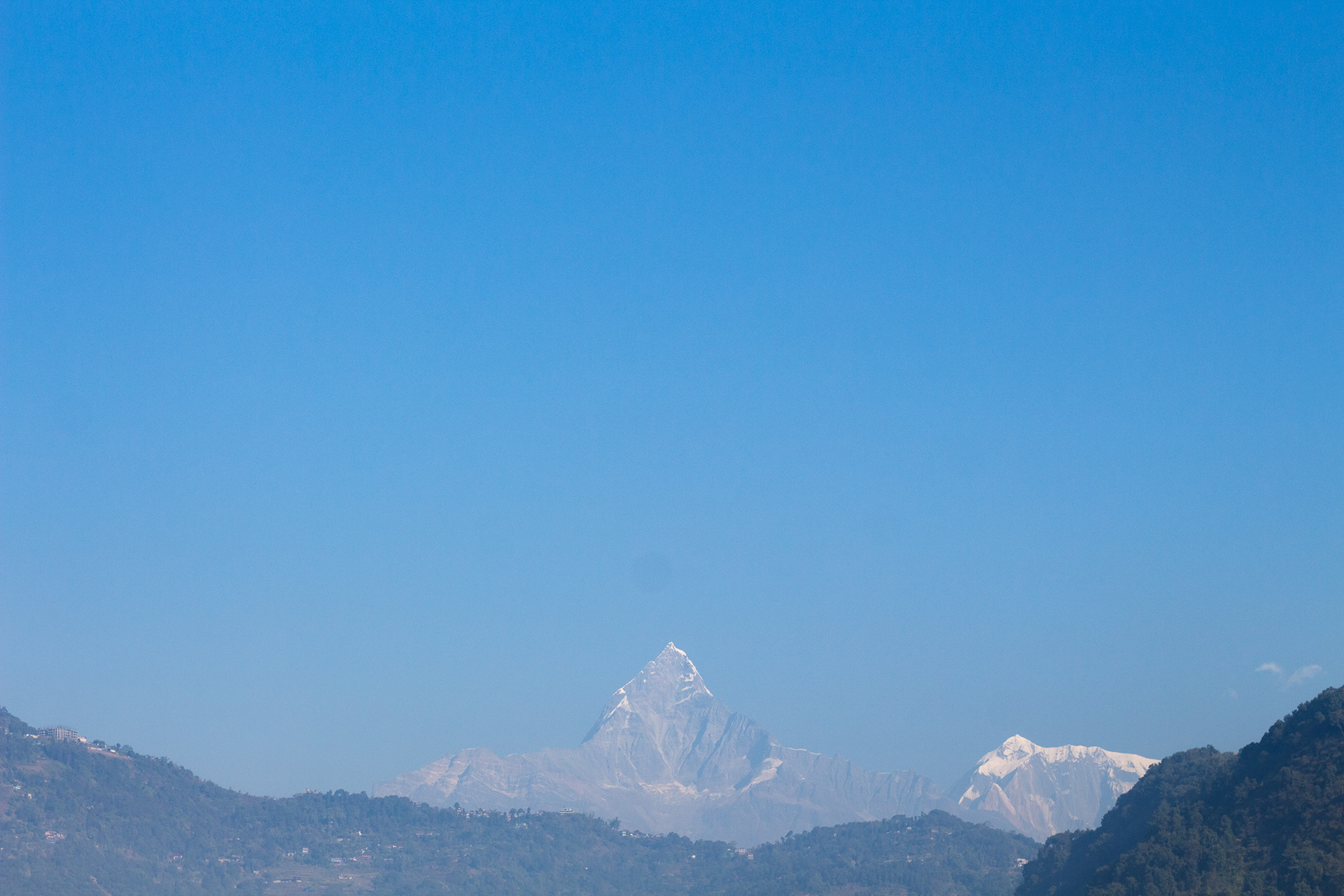
In December 2024, when I asked people in Nepal “how has climate change impacted you?” the most common response was that the mountains—which you could see from almost anywhere in the city—didn’t have as much snow as they used to.
Through their eyes, mountains were like monumental thermometers, interpreted as signs of Nepal’s overall ecological health. Mountains were more than just snow. They weren’t only geological landmarks, sources of water, or tourist destinations. Rather, they were cultural icons, economic lifelines, and symbols of something larger than ourselves—reminders of how small we humans are compared to the sublimity of the natural world.
This mix of meanings makes mountains more than just mountains. They become layered symbols that hold many different truths at once. Borrowing from Marisol de la Cadena’s anthropology in the Andes, we might say they are mountains but not only mountains. This way of seeing challenges us to go beyond separating the world into neat categories, thus “suspending the compartmentalization of the world and exceeding the categories that we mobilize to know it” (quoting Marina Otero Verzier).
Building on anthropologist Fernando Dominguez-Rubio’s definition of ecology as the “conditions in and through which something... exists, subsists, and becomes,” we can ask: what enables these categories of mountains(-but-not-only-mountains) to continue existing in the world?
How does knowledge about the environment shape how people imagine the future?
In The Three Ecologies (1989), philosopher Félix Guattari argued that our ways of thinking, our social structures, and the health of the environment are all deeply connected. Severed relations between people and land (under the umbrella of capitalism) cause or worsen the harms of climate change and natural disasters. Yet at the same time, climate change and natural disasters are potent shapers of the societies and lived experiences that impacted them in the first place. This is an example of the interdependency between what Guattari calls environmental ecology, social ecology, and mental ecology.
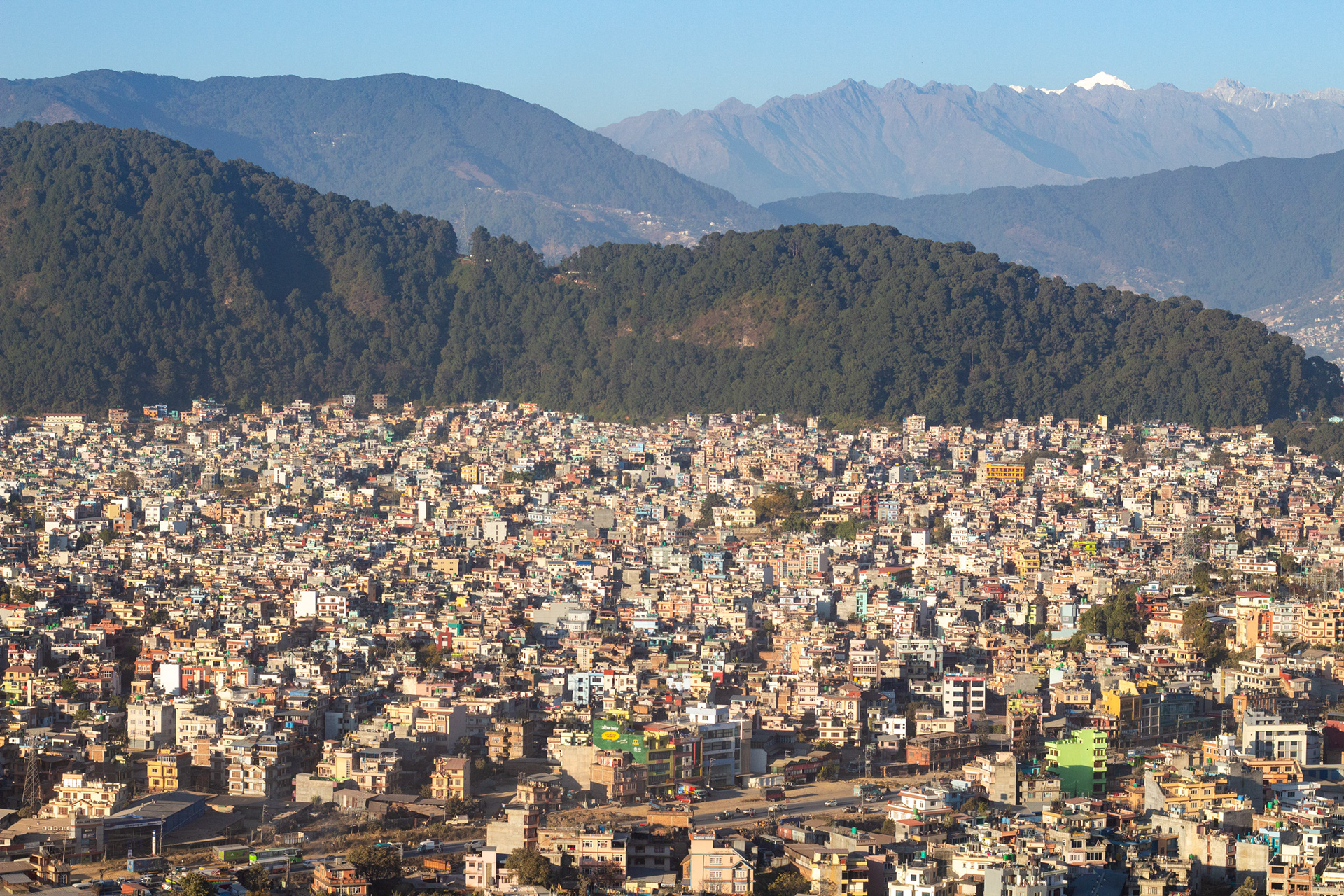
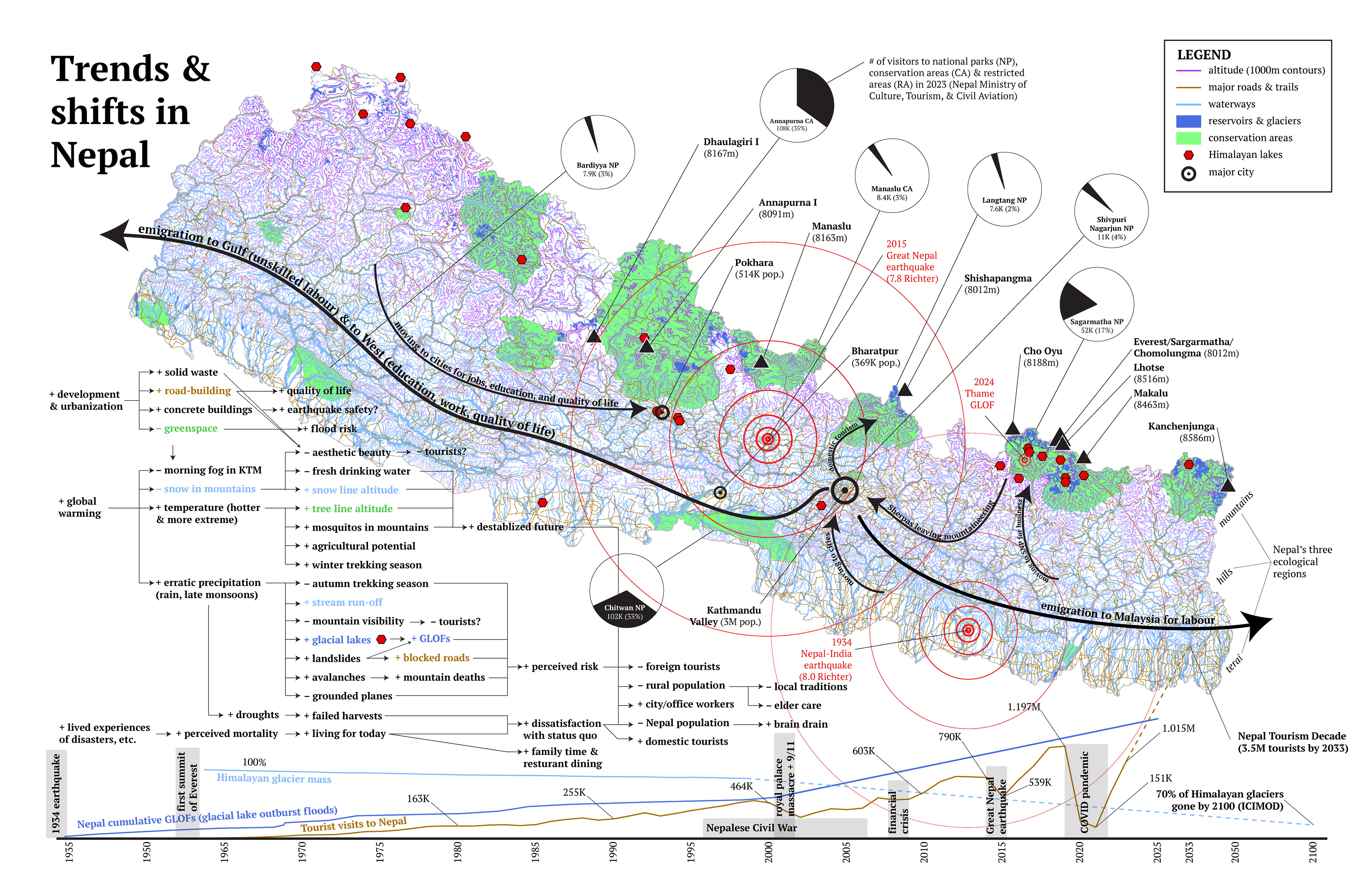
Service-providers in Nepal’s ecotourism industry are noticing shifts in mountain ecologies. Mountains are shifting more and more from baselines: there is less snow than before, rainfall is increasingly erratic, temperatures are becoming warmer or more extreme, and so forth. These shifts not only diminish natural beauty; they disrupt tourist itineraries and create real hazards for those who live and work in the mountains.
Part recency bias and part science, the risks and realities of climate change and natural disasters are casting shadows over people’s attitudes to life. Faced with the looming threat of glacial lake outburst floods, earthquakes, and melting glaciers, many locals are growing restless. The harder it is to imagine a stable life in the mountains, they more they leave for safer futures elsewhere.
We have caught the mountains at a turning point, a moment when the past and future are being reshaped by the changing environment—by diverse forms of pollution.
Pollution in the mountains is about more than just garbage. There are many different kinds of harm being done—some we can see, and some we can’t.
Solid waste is visible and easy to understand; there is tremendous work being done in Nepal on this. On the other hand, greenhouse gas emissions are recognized as dangerous, but I observed a sense of powerlessness on this front because Nepal sees itself as a small, agrarian country sandwiched between industrial powerhouses.
And then there’s a more invisible kind of pollution: the ecotourism industry itself, or the way tourism trains us to think about the environment as something to use up rather than care for. The current model of ecotourism in Nepal, while celebrated for bringing prosperity and attention to the mountains, is shaped by a mindset of extraction. Trekkers come to consume nature, and locals have built an impressive industry of hospitality, logistics, mobility, and waste management to facilitate said extraction.
These three forms of pollution—of land, of atmosphere, and of mindset—are all tangled together. When one dominates our vision, it makes the others harder to notice or act on. This creates blind spots that keep the industry stuck in short-term thinking and delay the work needed to build a more sustainable future—work that grows in urgency with every passing day.
What if ecotourism could be something else entirely? Imagine if visitors came to Nepal not to extract beauty from nature, but to learn from the mountains themselves—to witness firsthand the effects of climate change, to understand what’s being lost, and to support local efforts to adapt and protect. This would mean treating the Himalayas not just as a destination, but as a “time capsule” or “living archive,” where both environmental and cultural knowledge are preserved and passed on.
I envision Nepal’s ecotourism industry reframing itself from environmental extraction to environmental advocacy. Guides, lodge owners, and porters would serve not just as service-providers, but as curators, telling the story of a place transforming under pressure, inviting others to help imagine what comes next. This could empower stakeholders to perceive and intervene on all three forms of pollution while stewarding the country’s ecological well-being for future generations. In other words, it is a vision for Nepal as a climate change museum.
Essay abstract: This essay synthesizes perspectives and histories on three forms of pollution from stakeholders in Nepal’s ecotourism industry: solid waste (a tangible pollution of the land, which is easy to perceive and straightforward to intervene on), greenhouse gases (an intangible pollution of the atmosphere, which is easy to perceive but difficult to intervene on), and the ecotourism industry itself (a conceptual pollution of mindsets, which is both difficult to perceive and to intervene on). When entangled, these three forms of pollution induce epistemic blind spots that put ecotourism stakeholders at risk of overlooking a more holistic approach to sustaining the industry’s future. Said future does not rely on developing more efficient methods for getting rid of garbage; instead, it hinges on transitioning out of a mindset of extracting from nature for commercial gain. Reframing Nepal’s ecotourism industry as an environmental advocacy practice, where visitors come to witness the effects of climate change, could empower stakeholders to perceive and intervene on all three forms of pollution while stewarding the country’s ecological well-being for future generations.
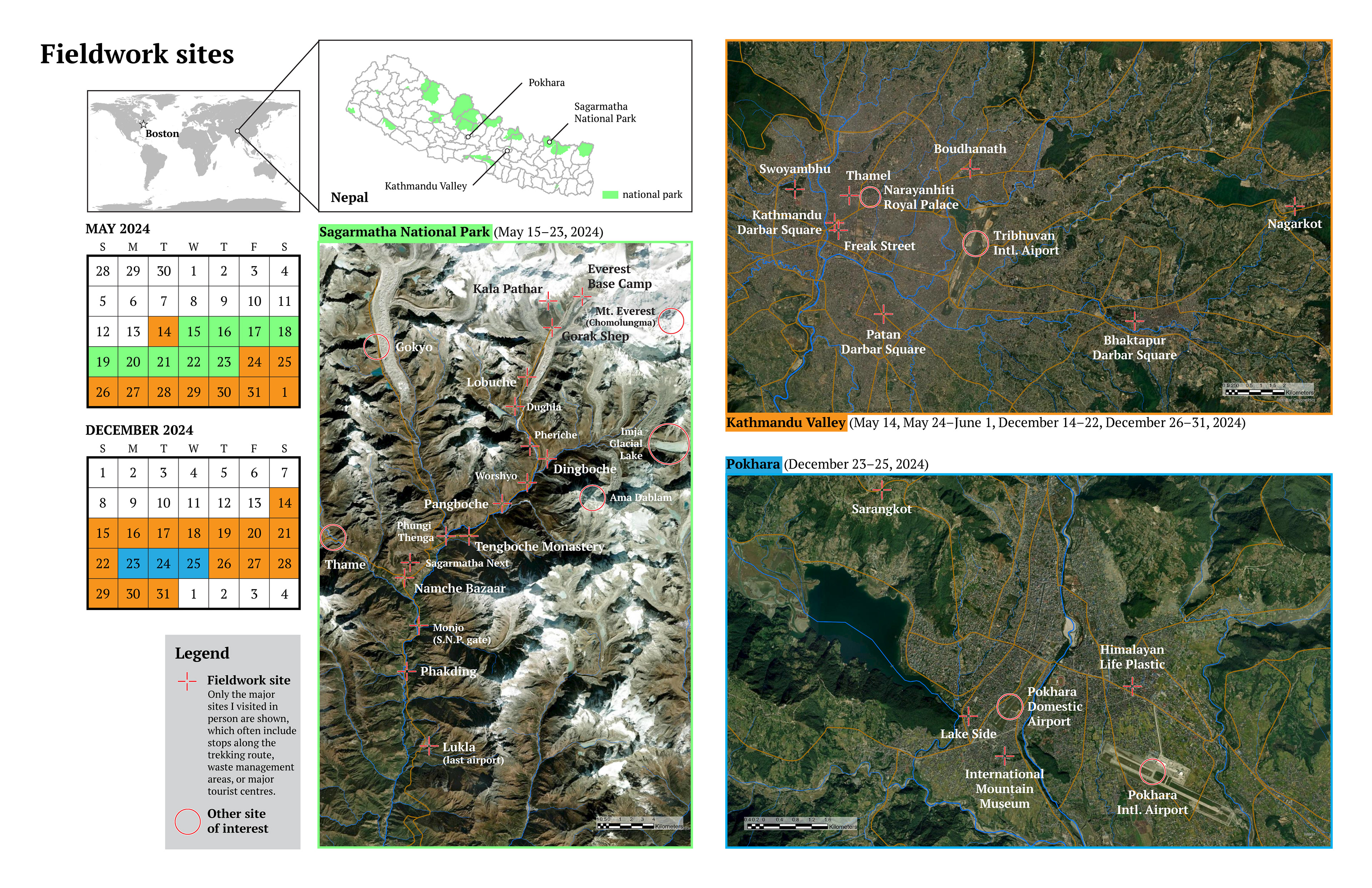
My arguments in this section are grounded in interviews and site observations I conducted during 33 days in Nepal in May and December 2024—a mountain of data about mountains.
Rather than write an anthropological text, however, I put on my “design research hat” and pursued a more pragmatic ways to demonstrate the potential of ecotourism as an environmental advocacy practice. After all, design research isn’t about simplifying complex topics into elegant insights; instead, it’s about finding complex interventions for navigating through a complex world, about preserving complexity in the output. There was something powerful and captivating in the raw words and language that my interviewees used to narrate their stories. I had to let this shine through.
Inspired by Dove & Kammen’s essay “The Virtues of Mundane Science,” I thought about the word “mundane” which comes from mundus, the Latin word meaning “world.” The essay reminds us to value everyday, practical ways of understanding the world—not just high-brow academic theories.
Climate change doesn’t only affect people over there; it affects everything, everywhere. It is not local; it is glocal. It is not extraordinary; it is mundane. Climate change has become what philosopher Timothy Morton calls a “hyperobject”—impossible to fully grasp because it’s so pervasive and inescapable. Well, can the mountains themselves also become a kind of “hyperobject” to help them sustain their categories in the face of diaspora and cultural disruptions? How might we translate the mountains into the mundane?
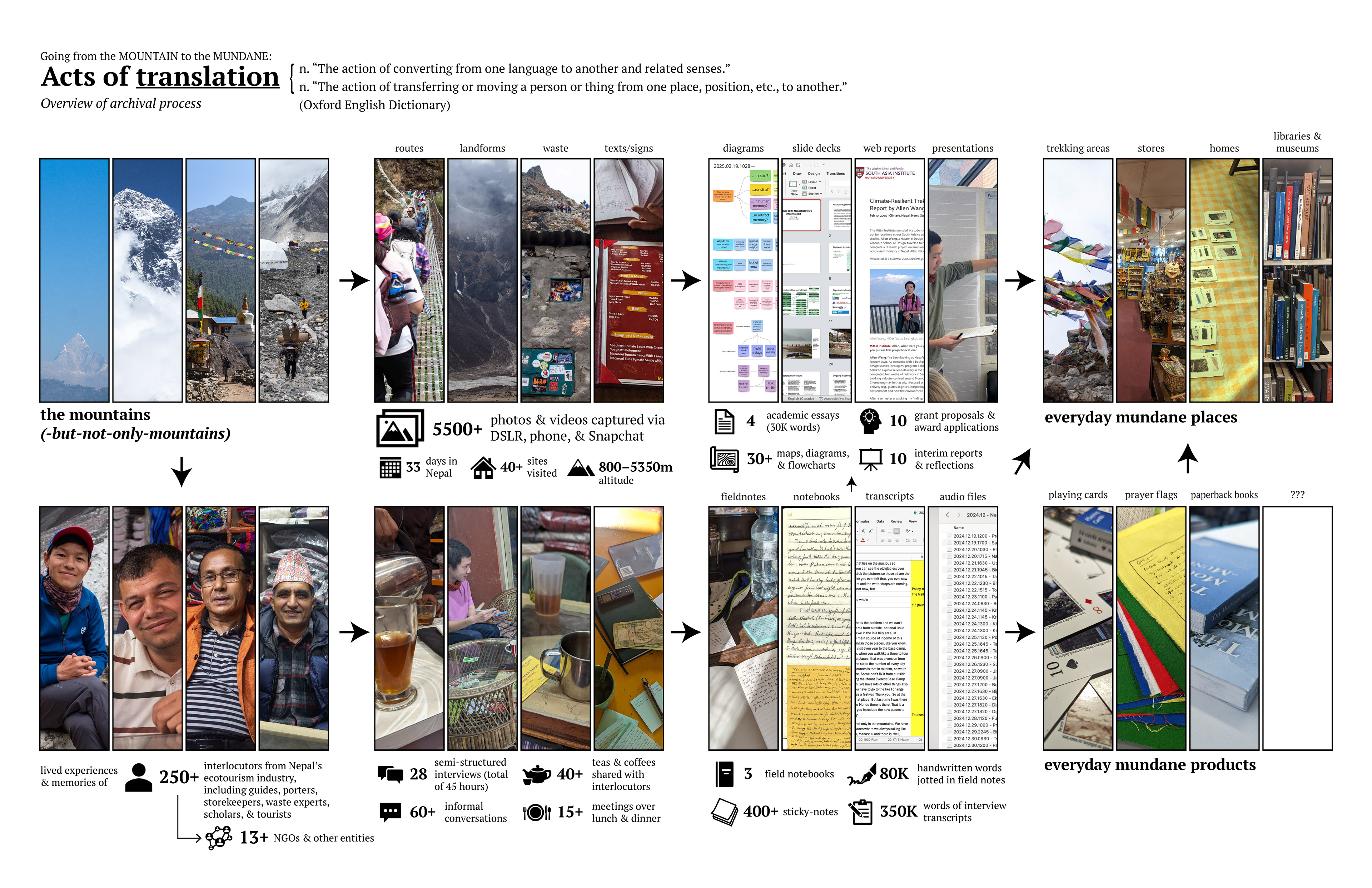
My project is about translating my fieldwork data into time capsules to capture this moment of metamorphosis. But these time capsules aren’t buried underground. Instead, these are archives integrated into the world around us, embedded into everyday objects that people can use, exchange, and interact with intimately. This is an experimental archival practice based on proximity and familiarization into everyday places, not isolation and preservation in climate-controlled museums. They are ways to carry pieces of the mountains with us wherever we go.
Translation isn’t just to convert from one language (or medium) to another, but also to move something from one place to another. By breaking down big, complex experiences into smaller, modular pieces, the stories of the mountains become easier to understand, to share, and to keep alive—wherever they are.
This is the meaning of the MOUNTAIN-MUNDANE.
Part
Two:
Making
Two:
Making
Following the MOUNTAIN-MUNDANE manifesto, I created three prototypes (among many possibilities): playing cards, prayer flags, and paperback books.
Each prototype is a tangible product that the user builds intimacy with over time, because it has familiar uses outside of its archival function in this project. In unique ways, each prototype packages dense data into approachable, page-by-page formats that can be mass-produced (via digital or analogue methods). Their portability allows you to buy them in a store, carry them with you on a trek, bring them home as souvenirs, and gift them to a friend.
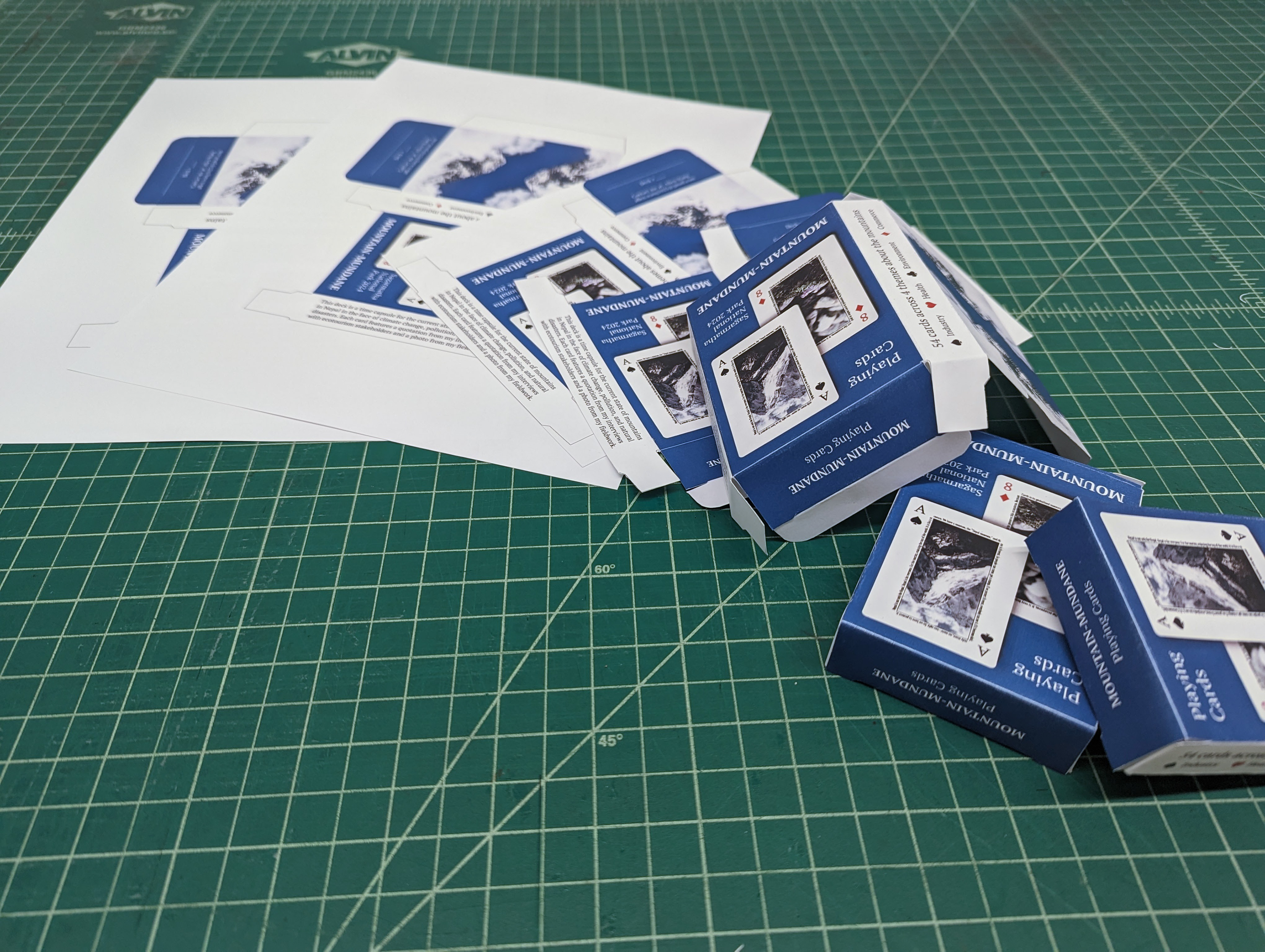
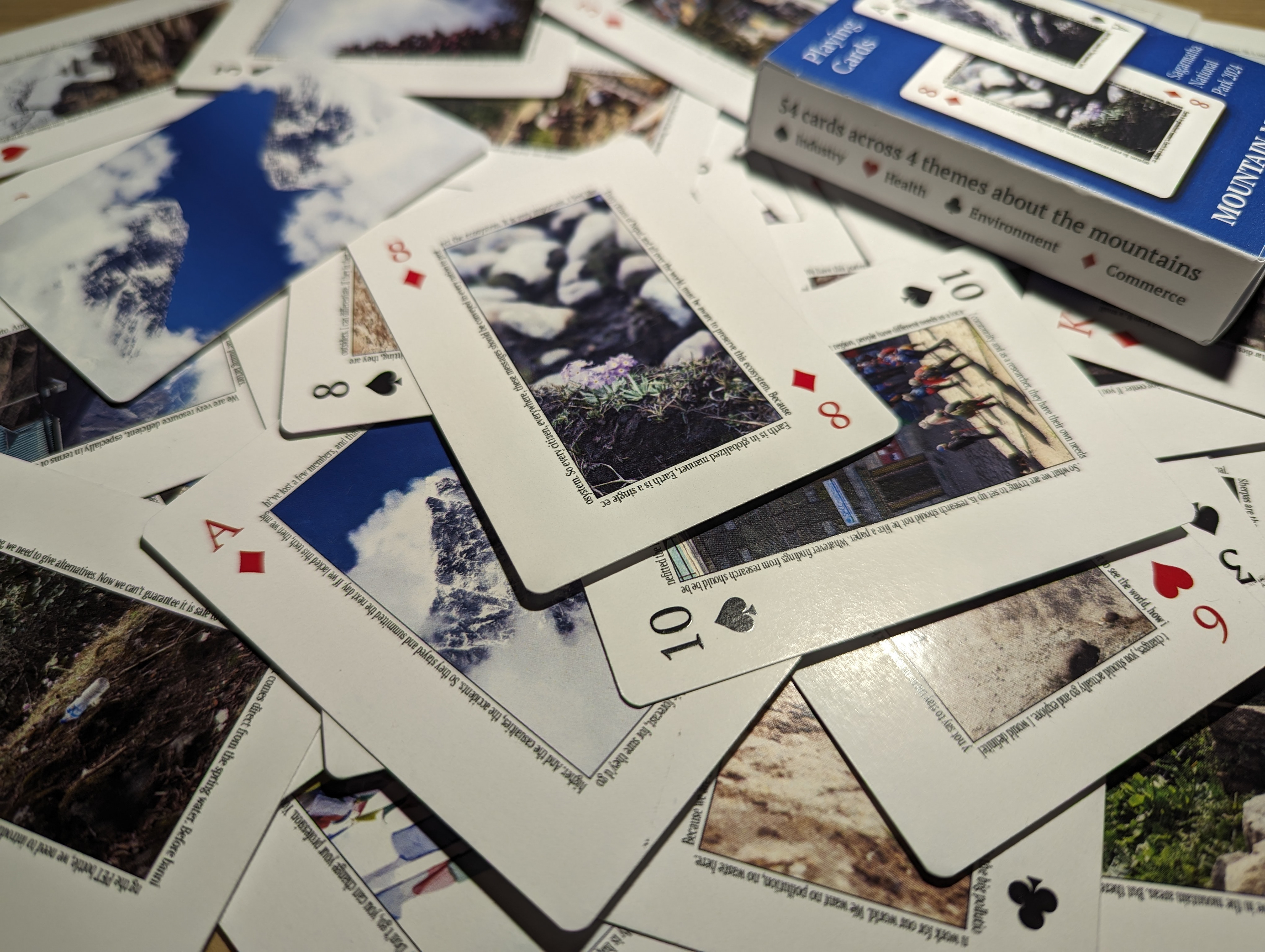
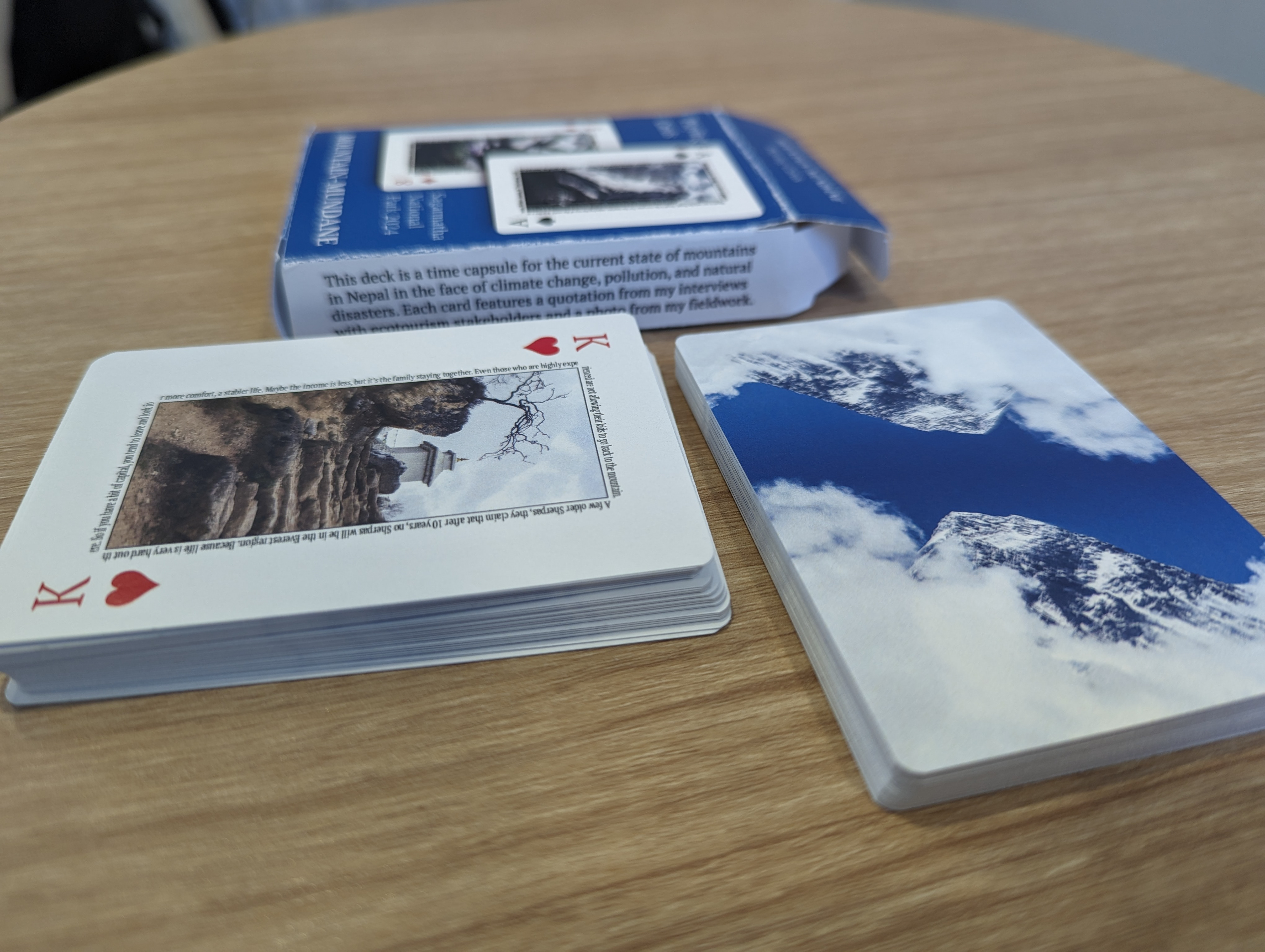
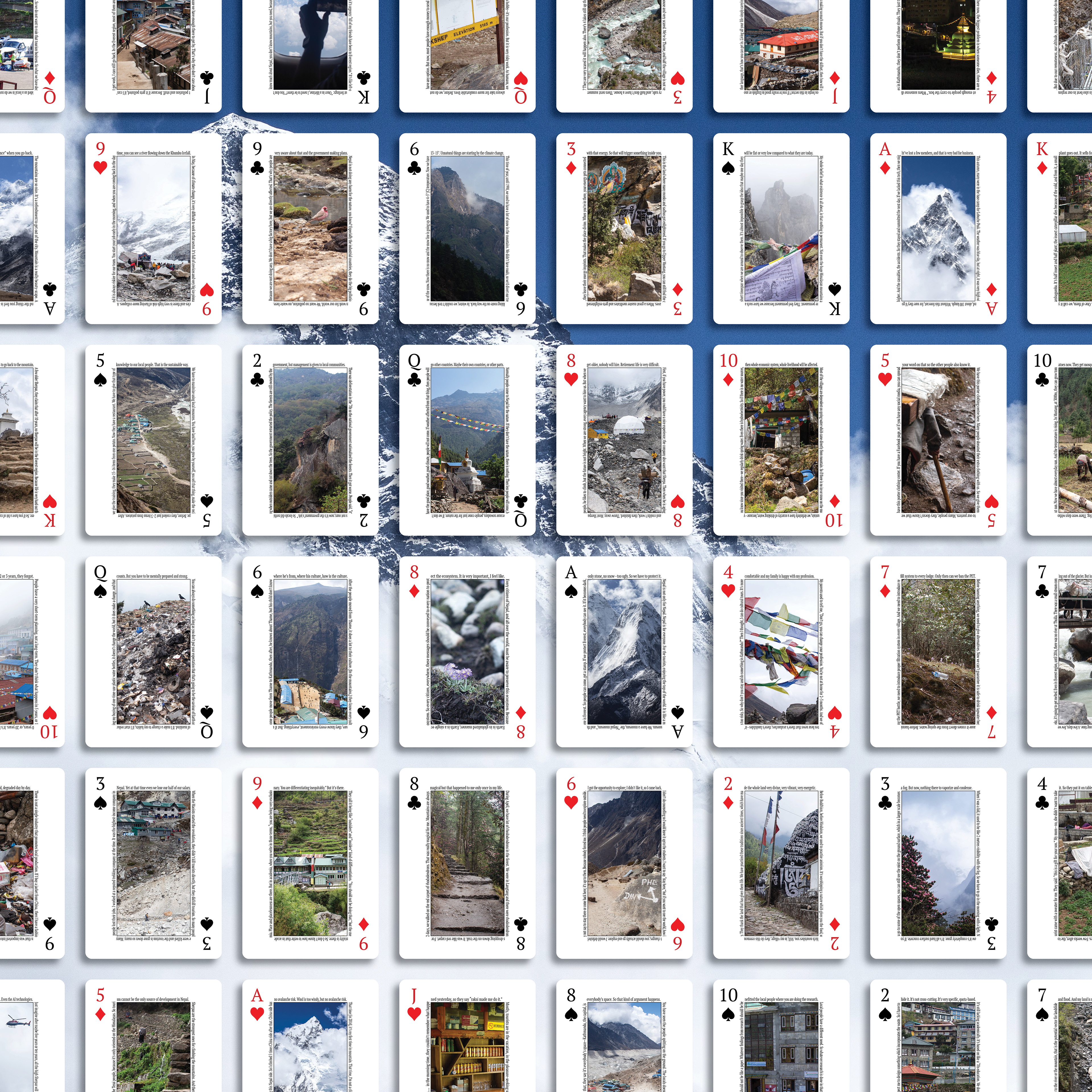
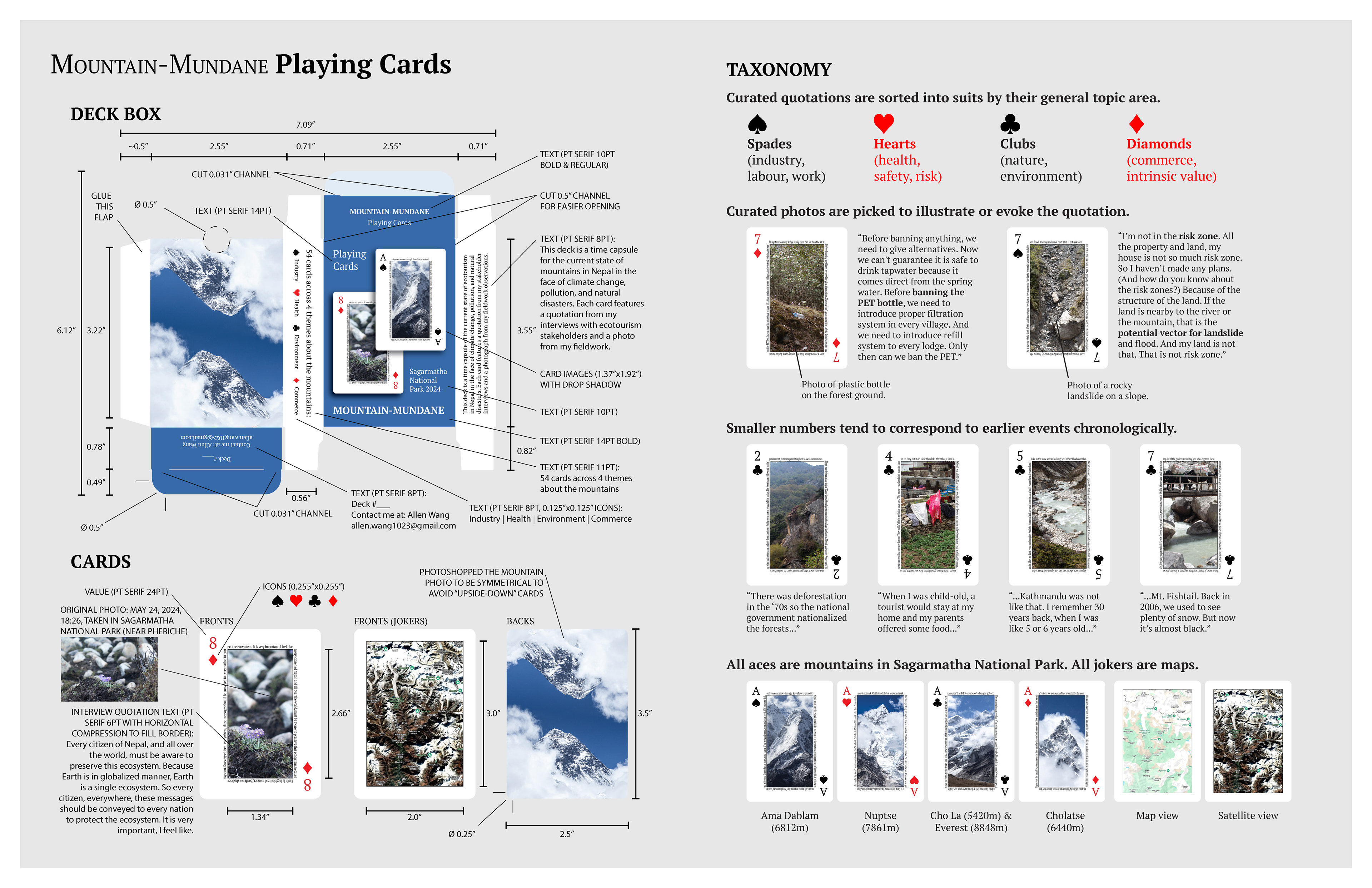
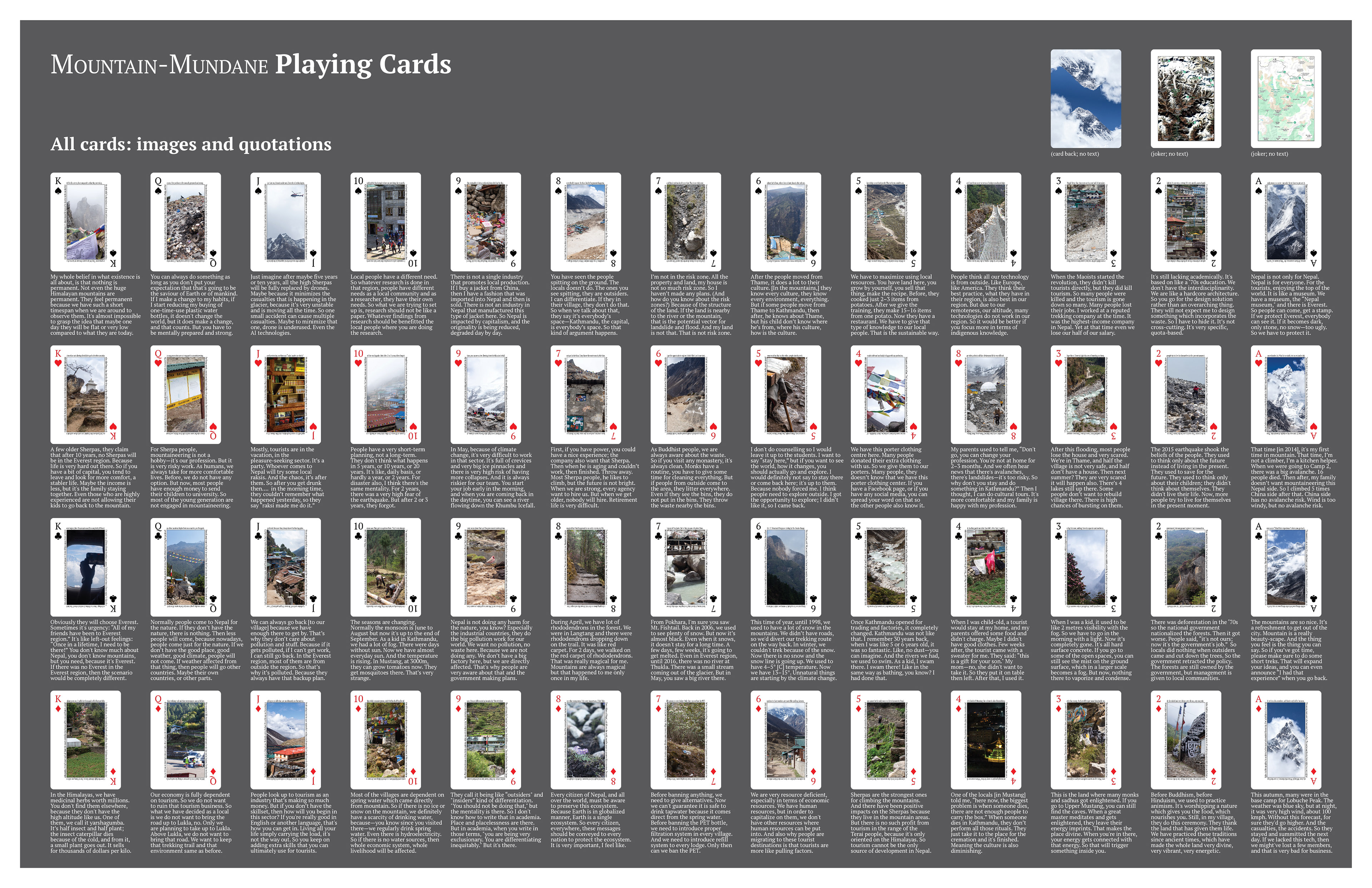
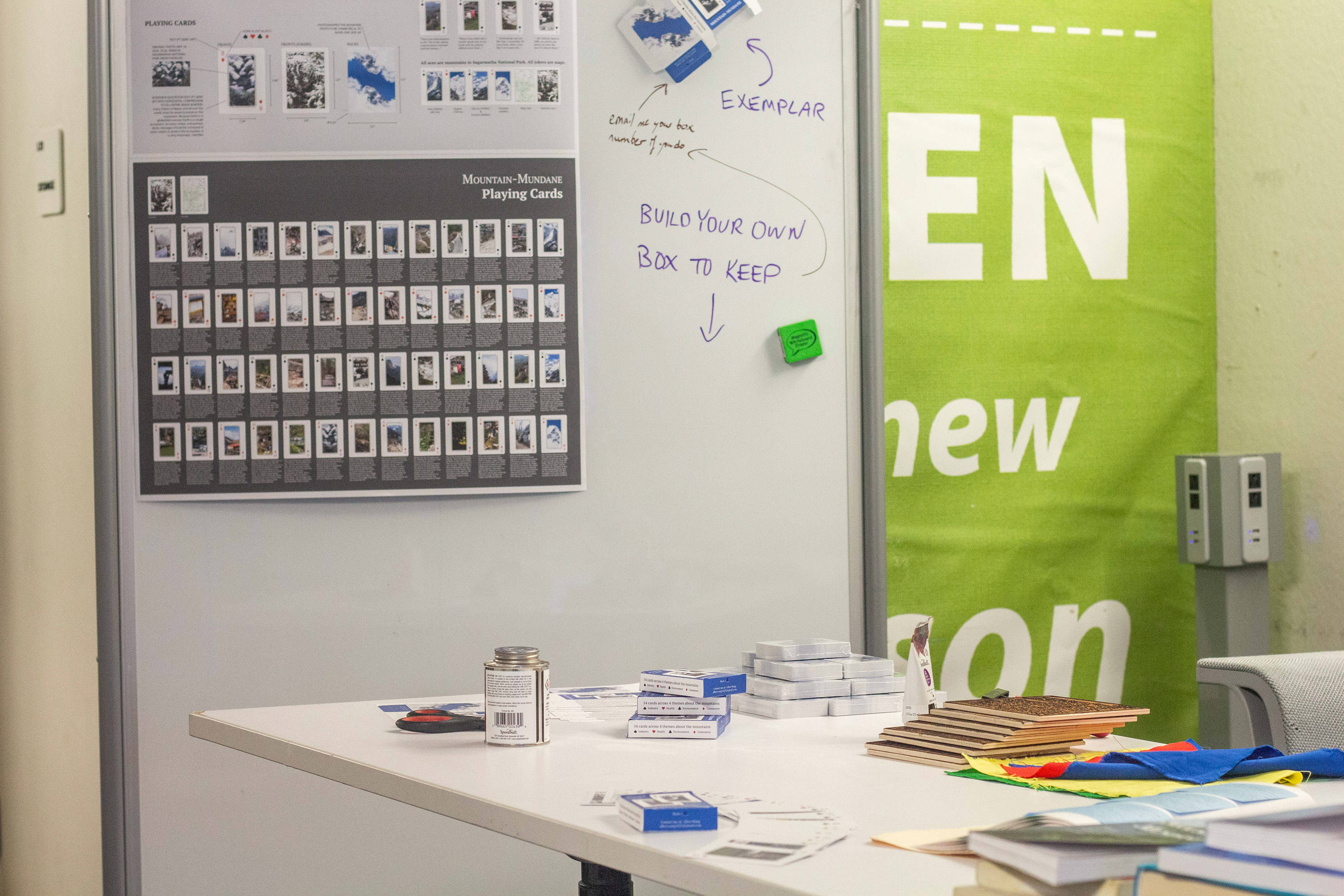
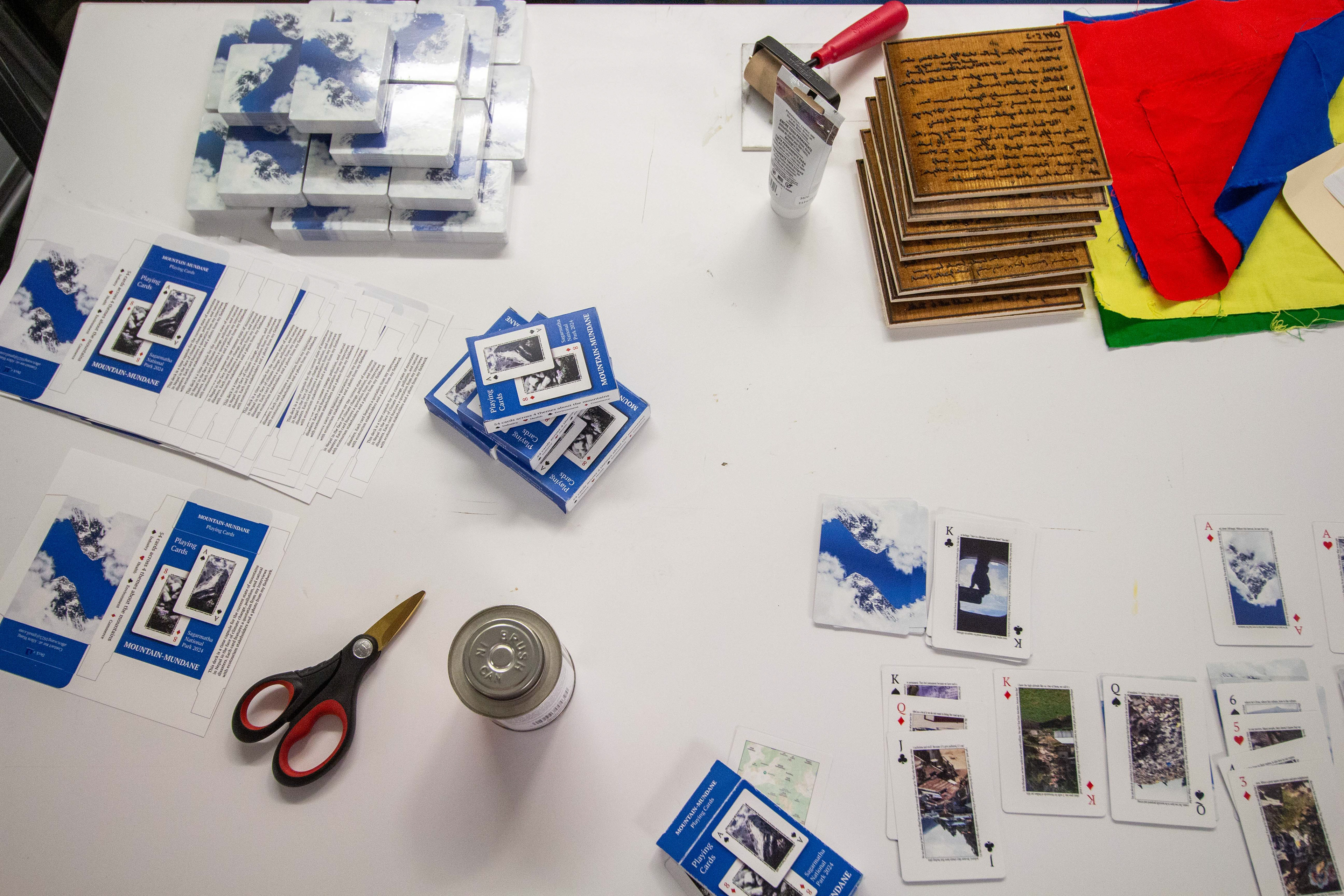
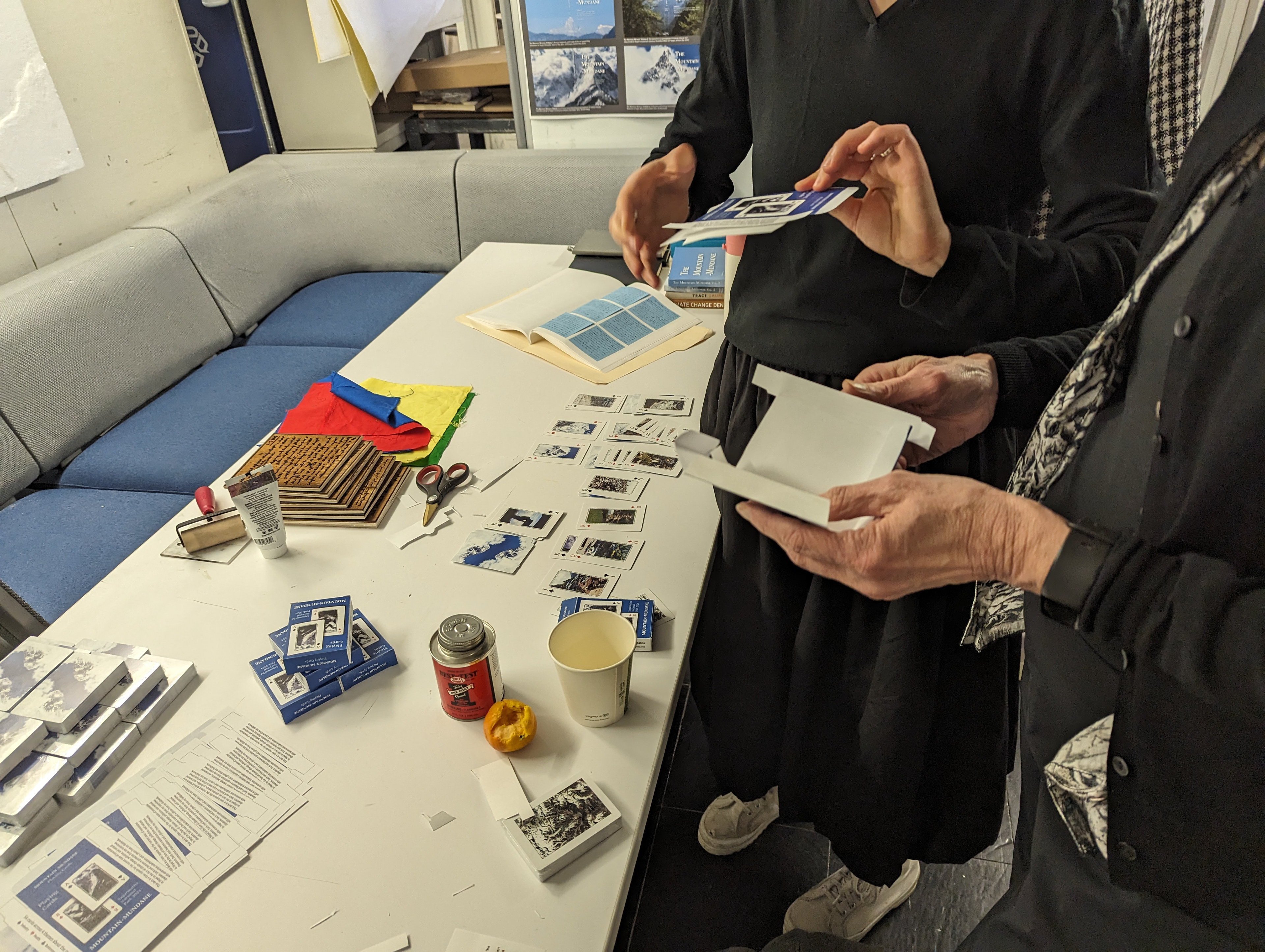
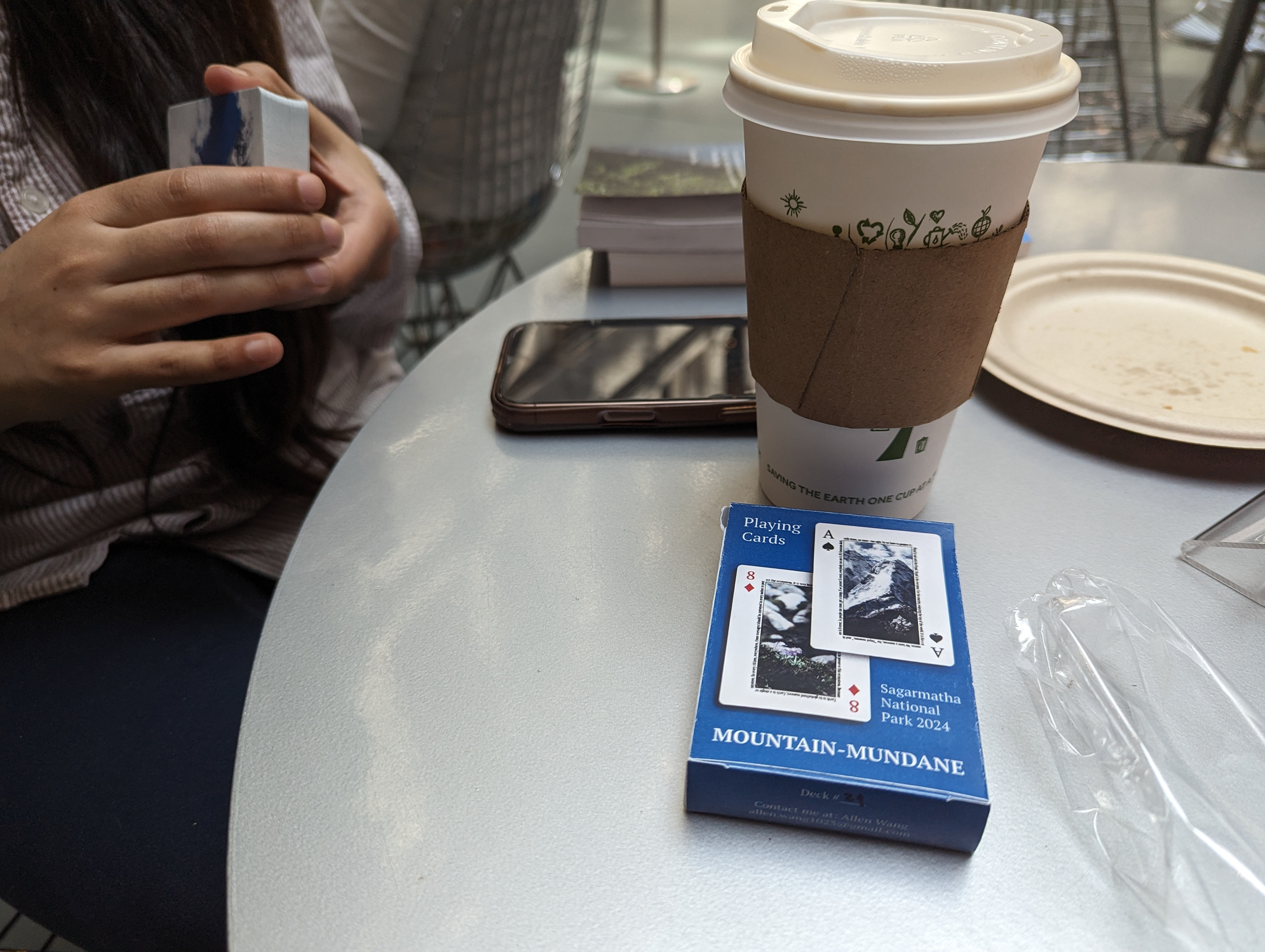
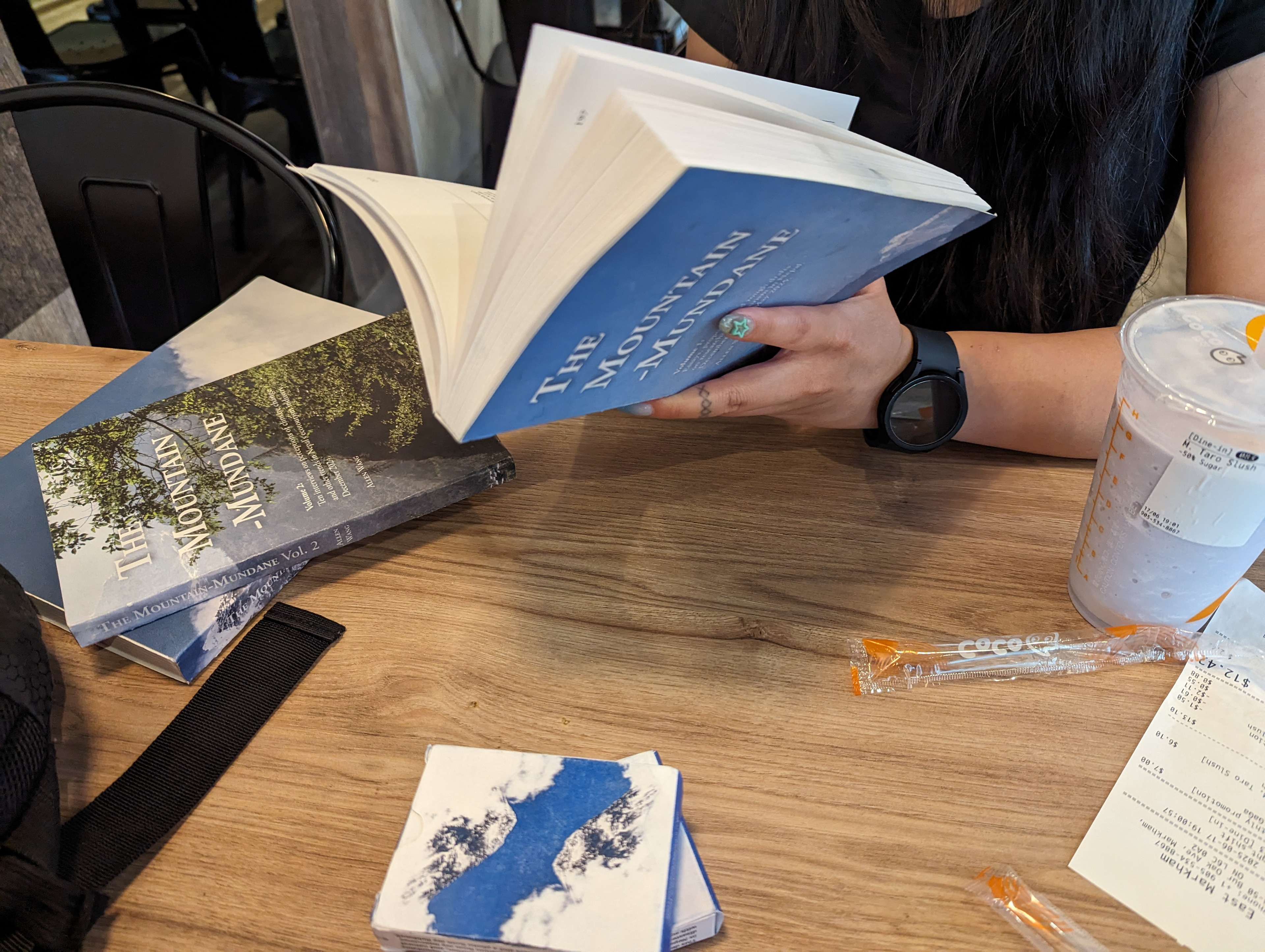
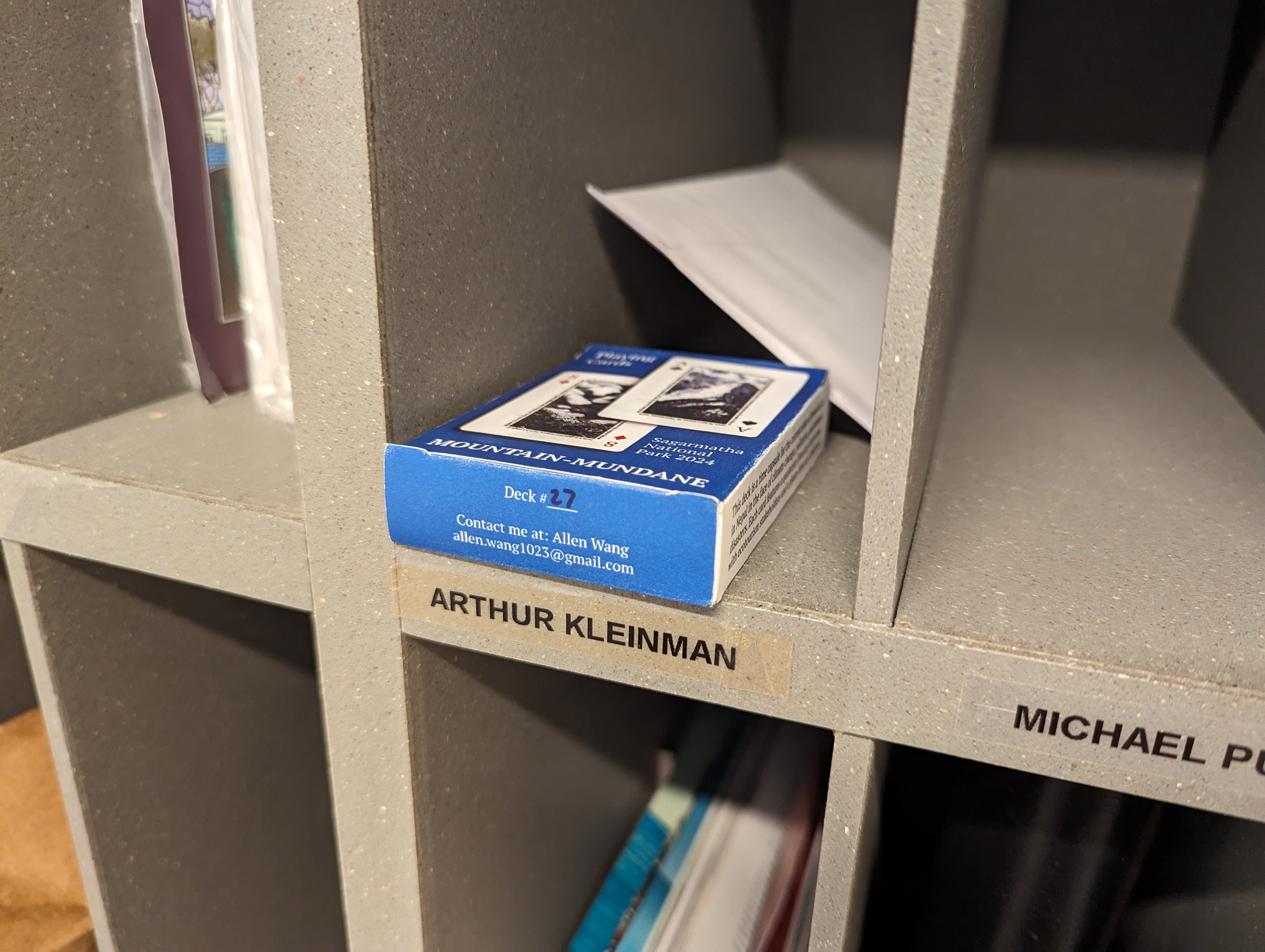
PROTOTYPE ONE: Playing cards illustrated with photos of mountains and interview quotations from my fieldwork. Each box has a unique number on it for identification. Cards are a common item in packing lists for trekkers because they give you a way to pass the time at the end of a long day. You can play your usual games with these, but you can also read what’s on them when you’re bored. I designed 54 cards (which I got professionally printed), as well as a box which I printed, cut, and assembled by hand. I made forty decks in all.
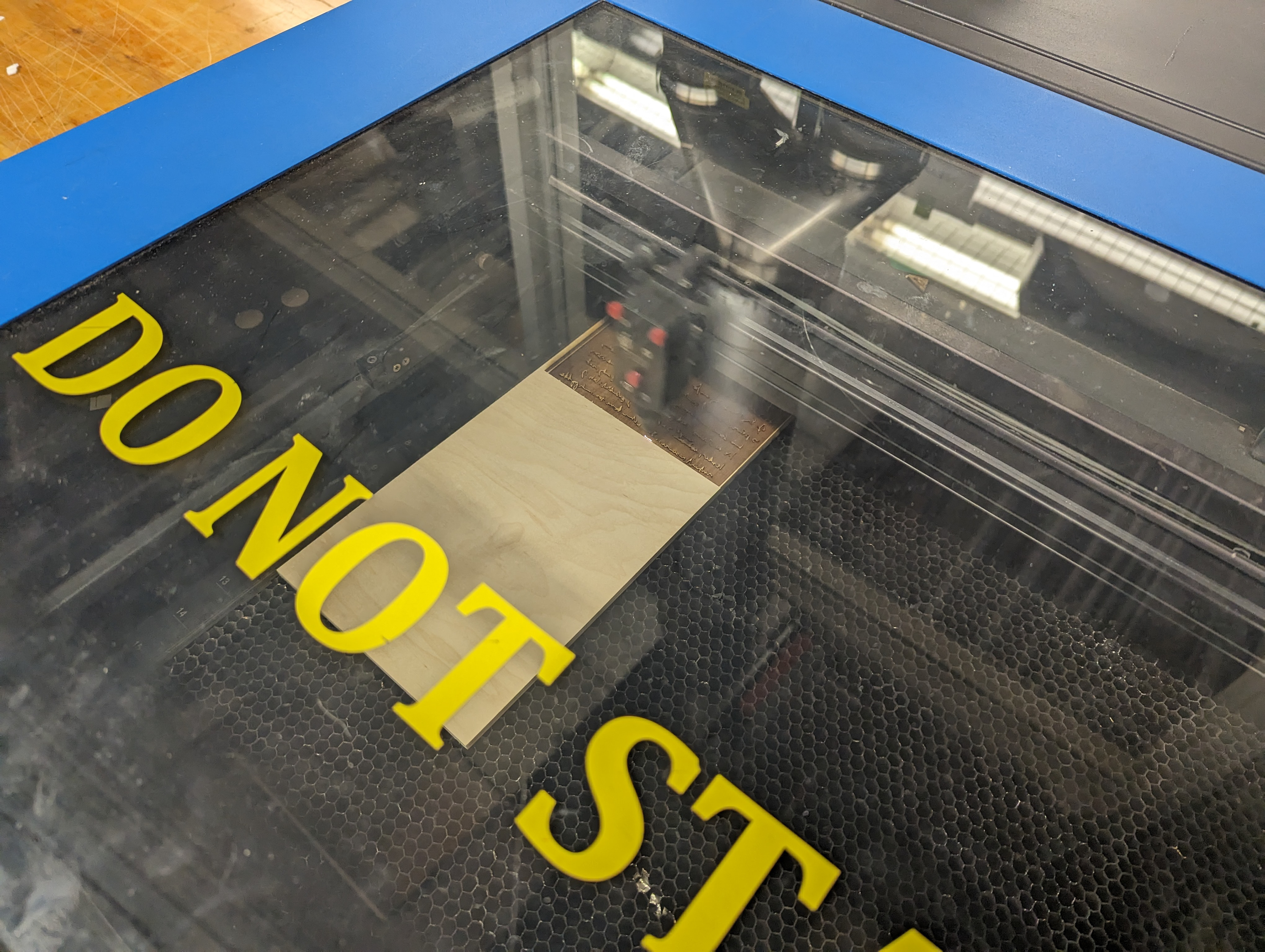
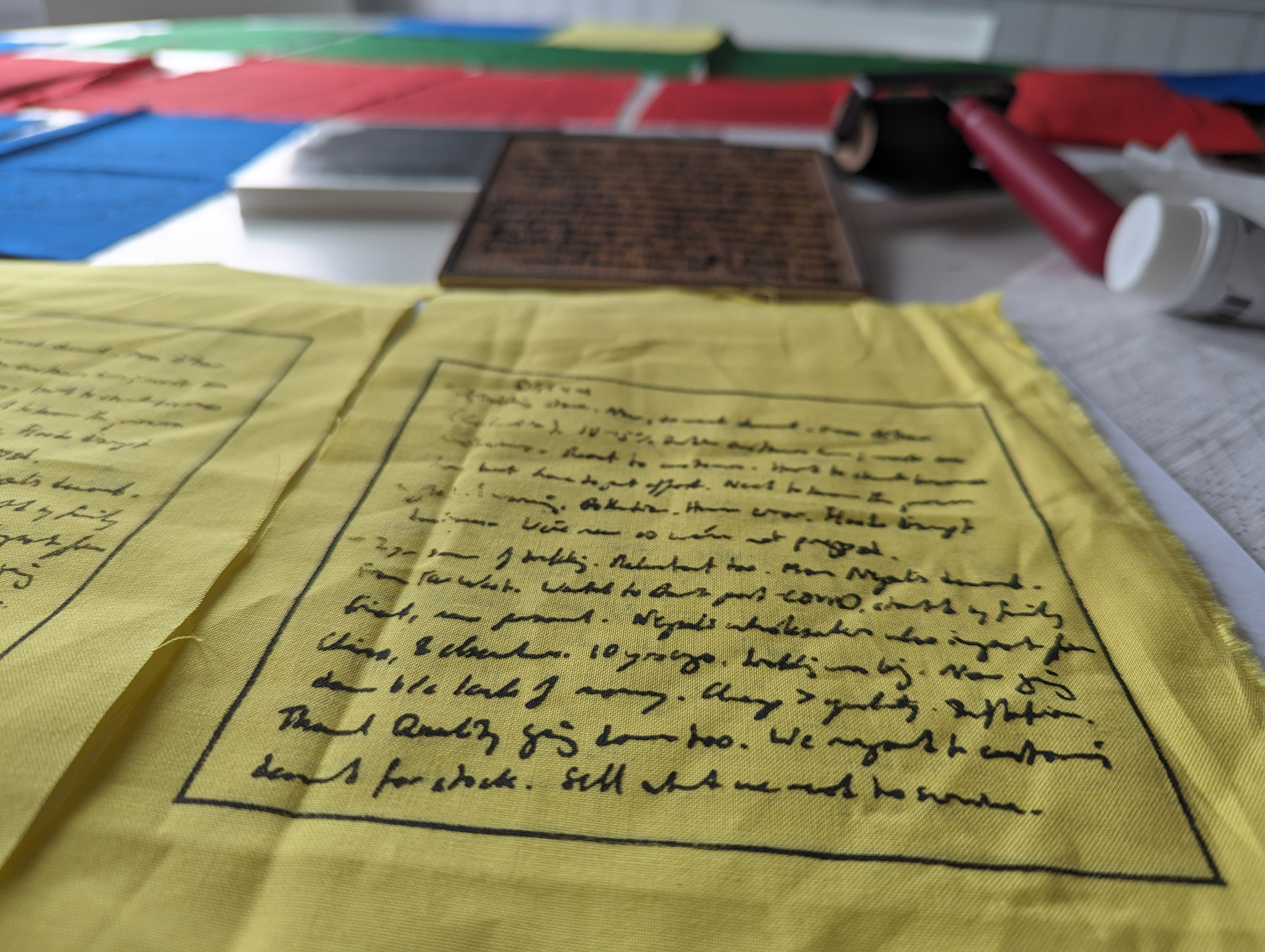
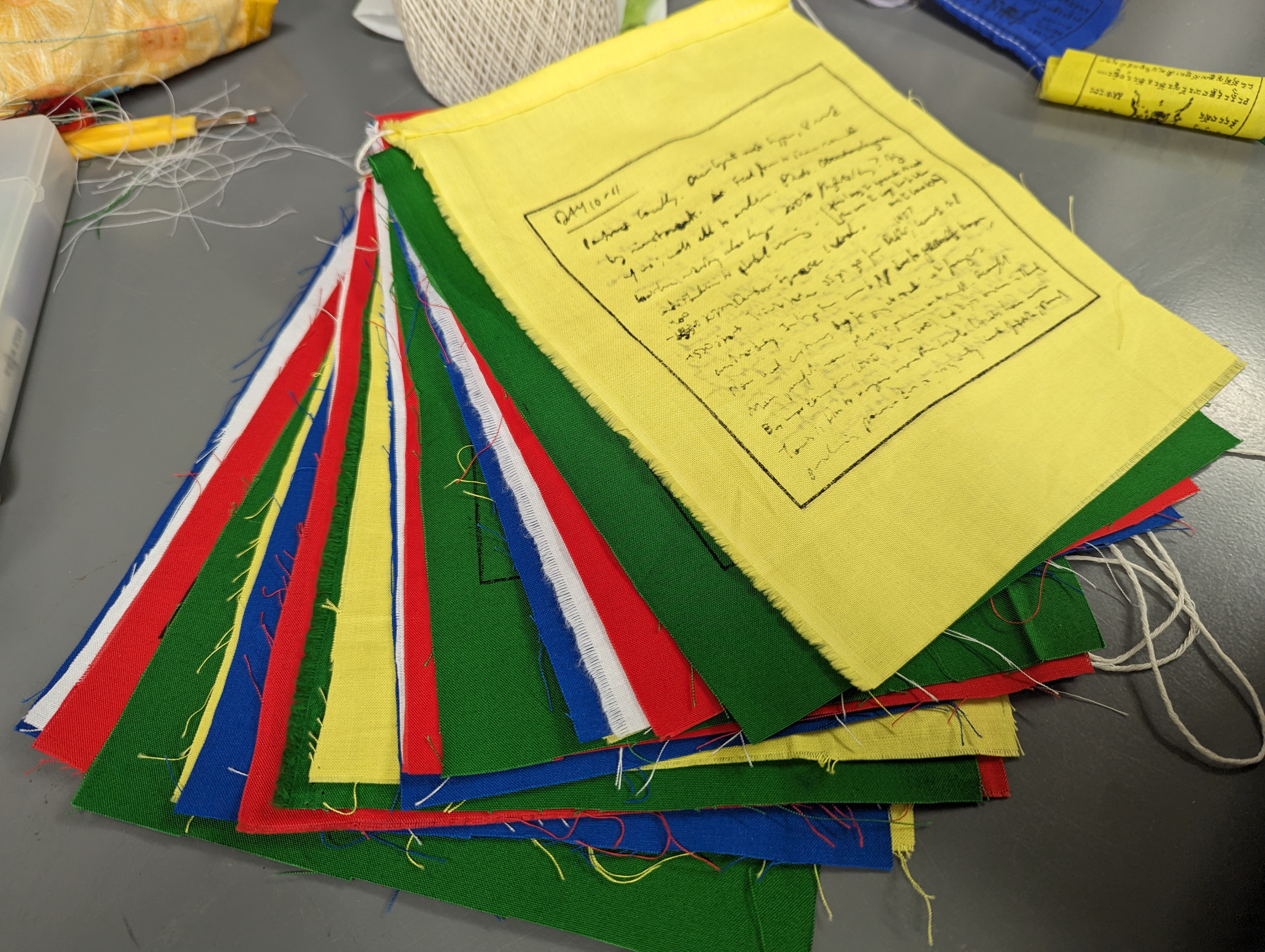
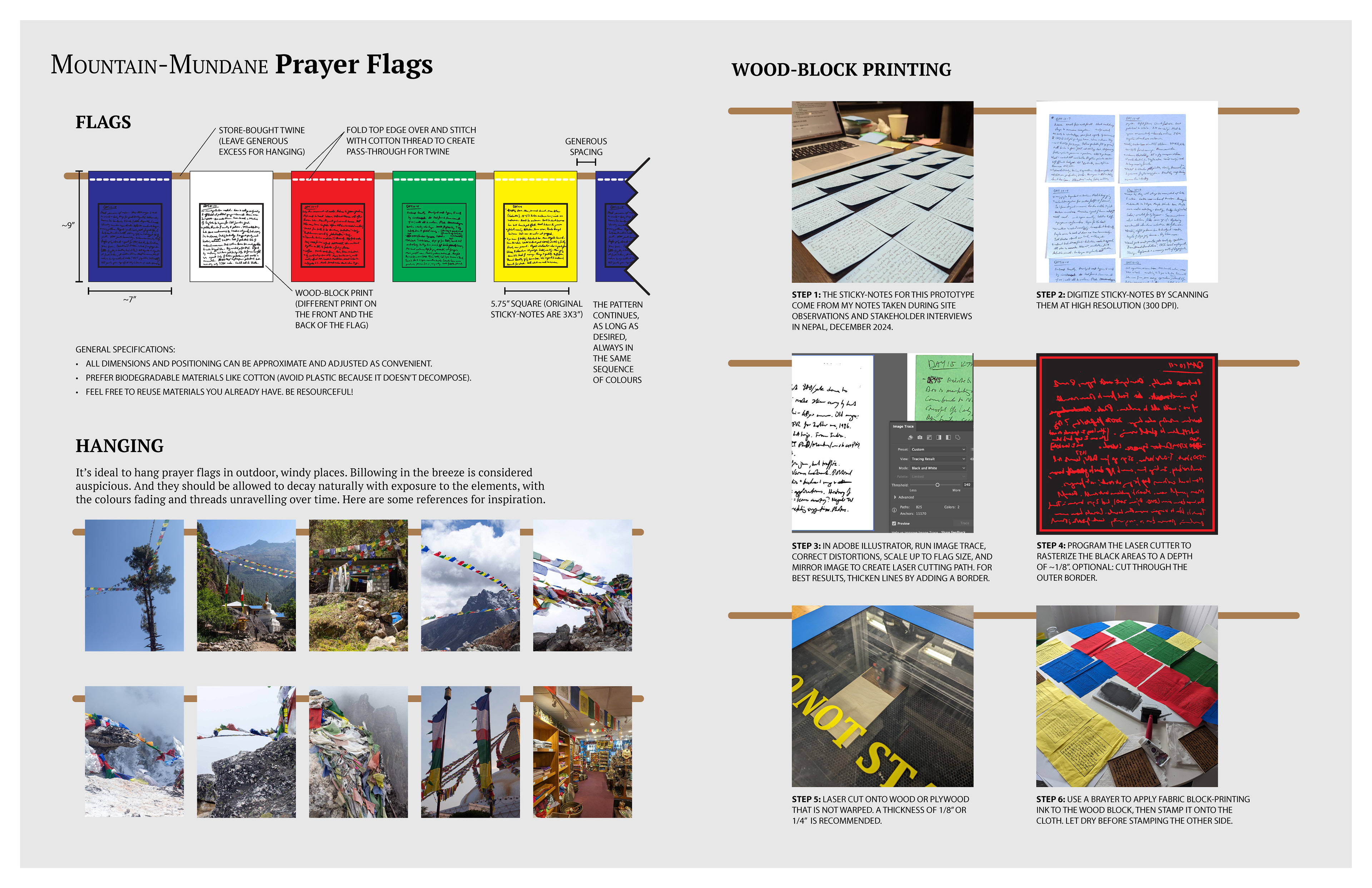
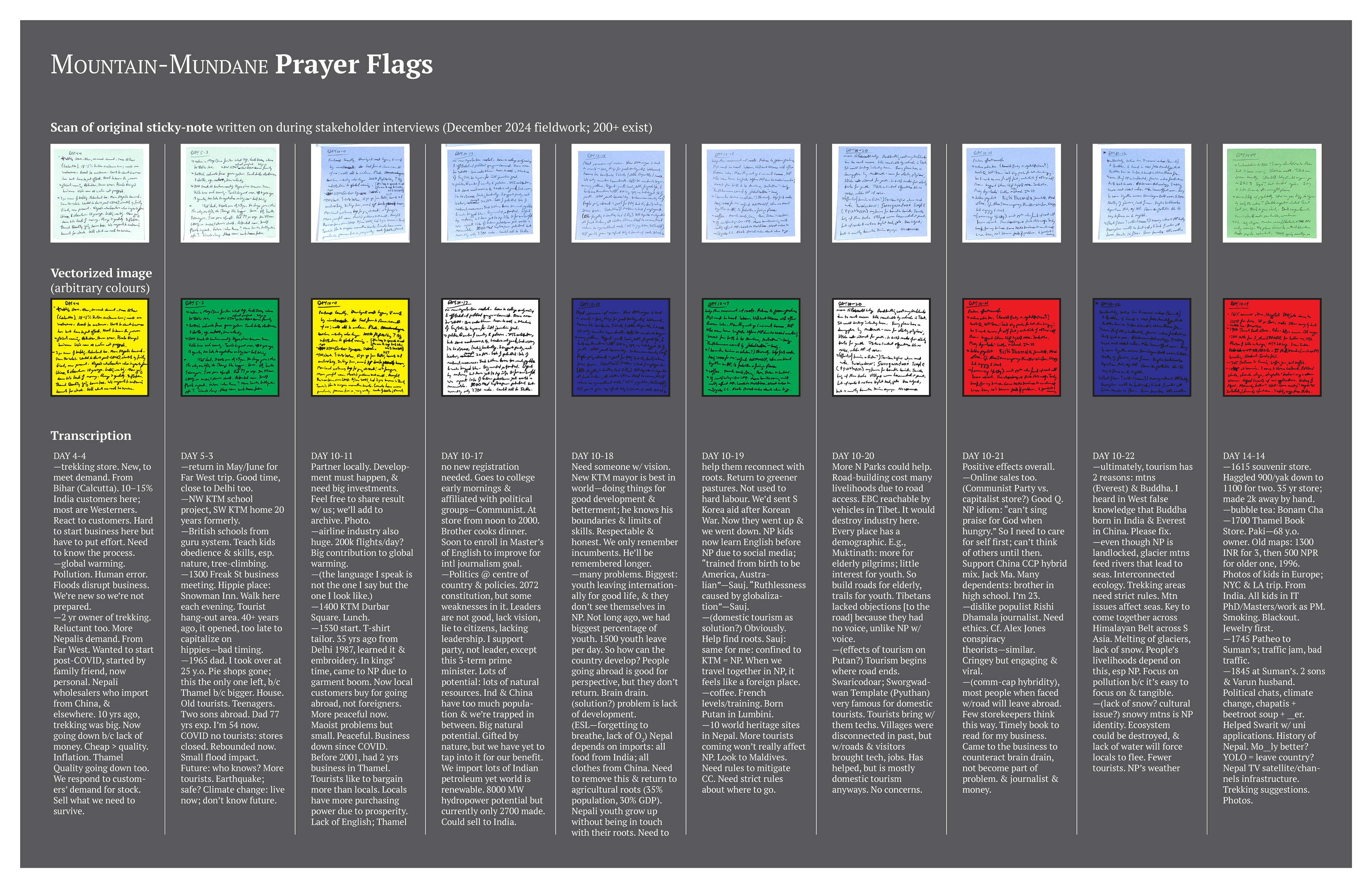
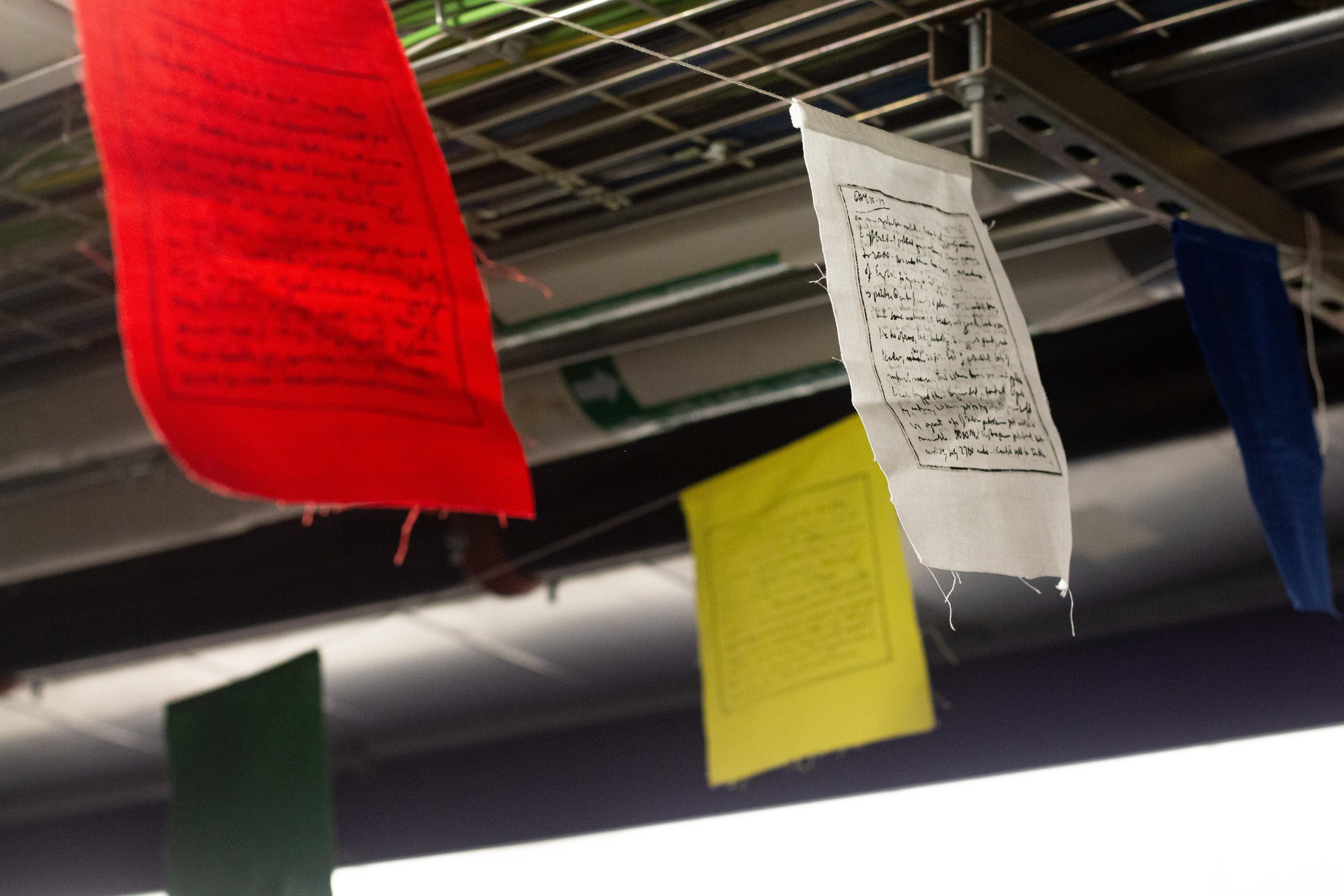
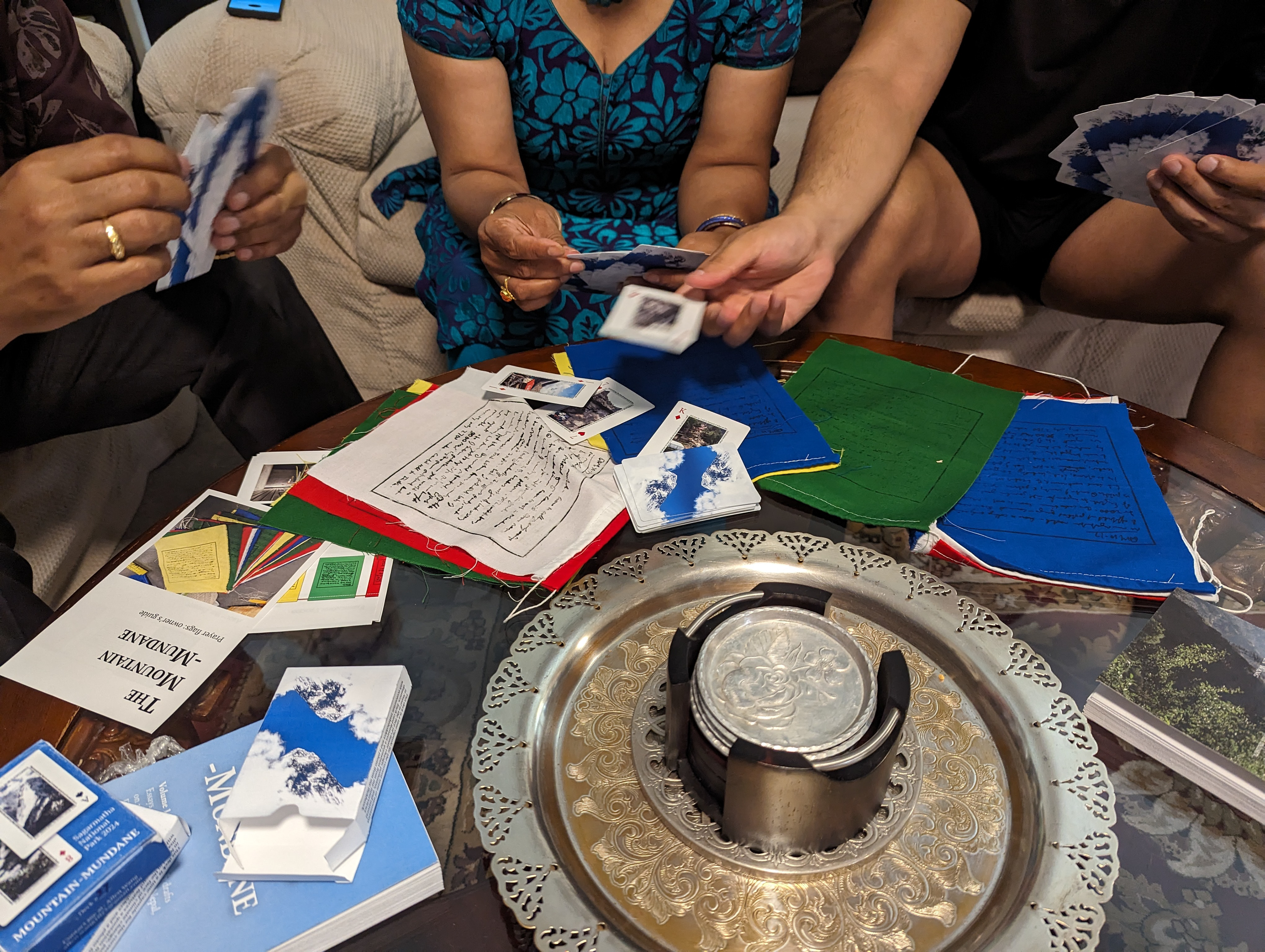
PROTOTYPE TWO: Prayer flags with woodblock prints of sticky-notes containing handwritten jottings from my fieldwork interviews (mostly on storekeepers’ worries about the present-day and their aspirations for the future). From afar, they resemble Tibetan prayer flags; only up close is it clear that the text is English. Prayer flags are a common sight along trekking trails. I laser-cut eight woodblocks, stamped 25 pieces of cotton fabric by hand, then strung them together.
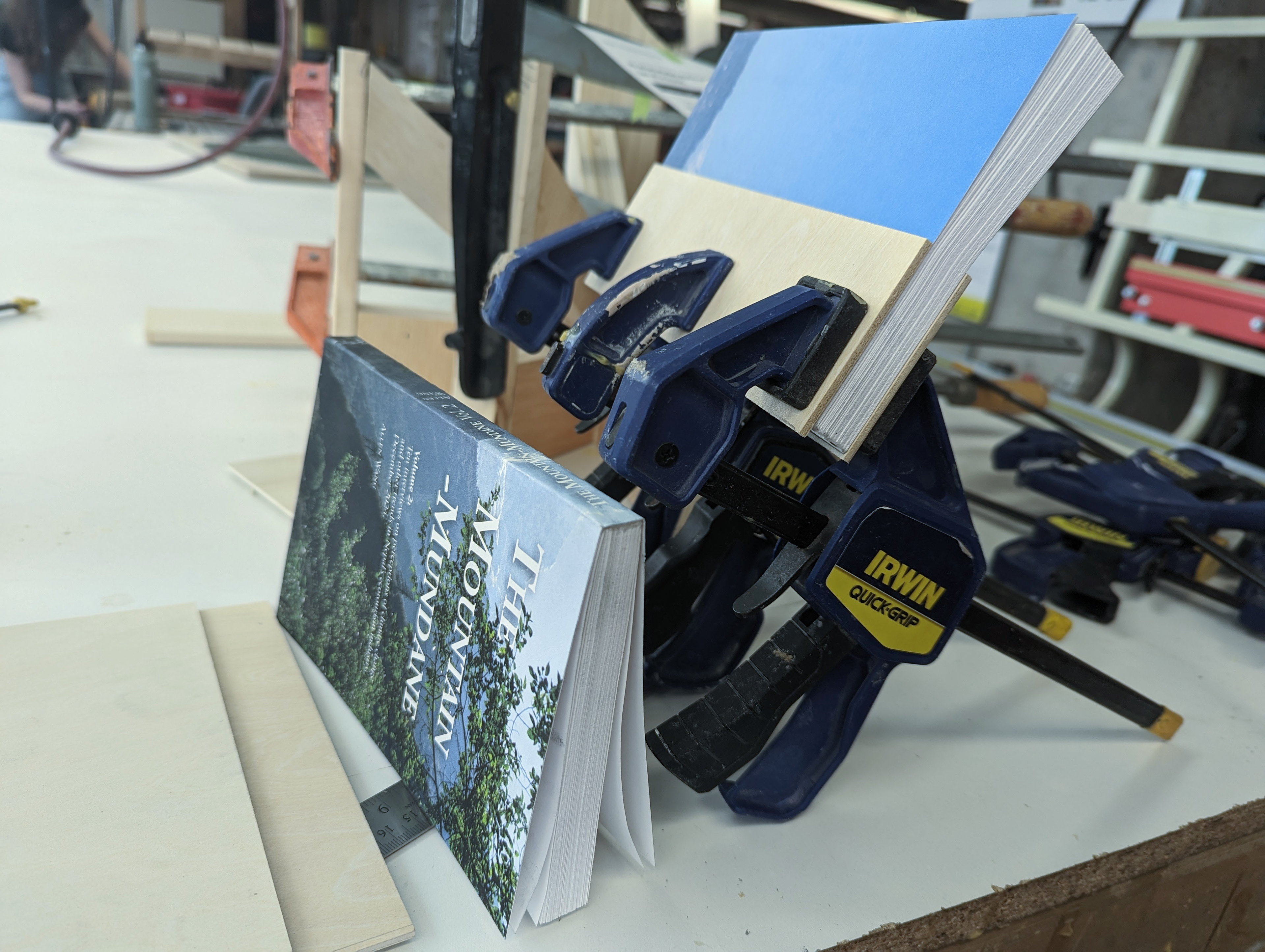
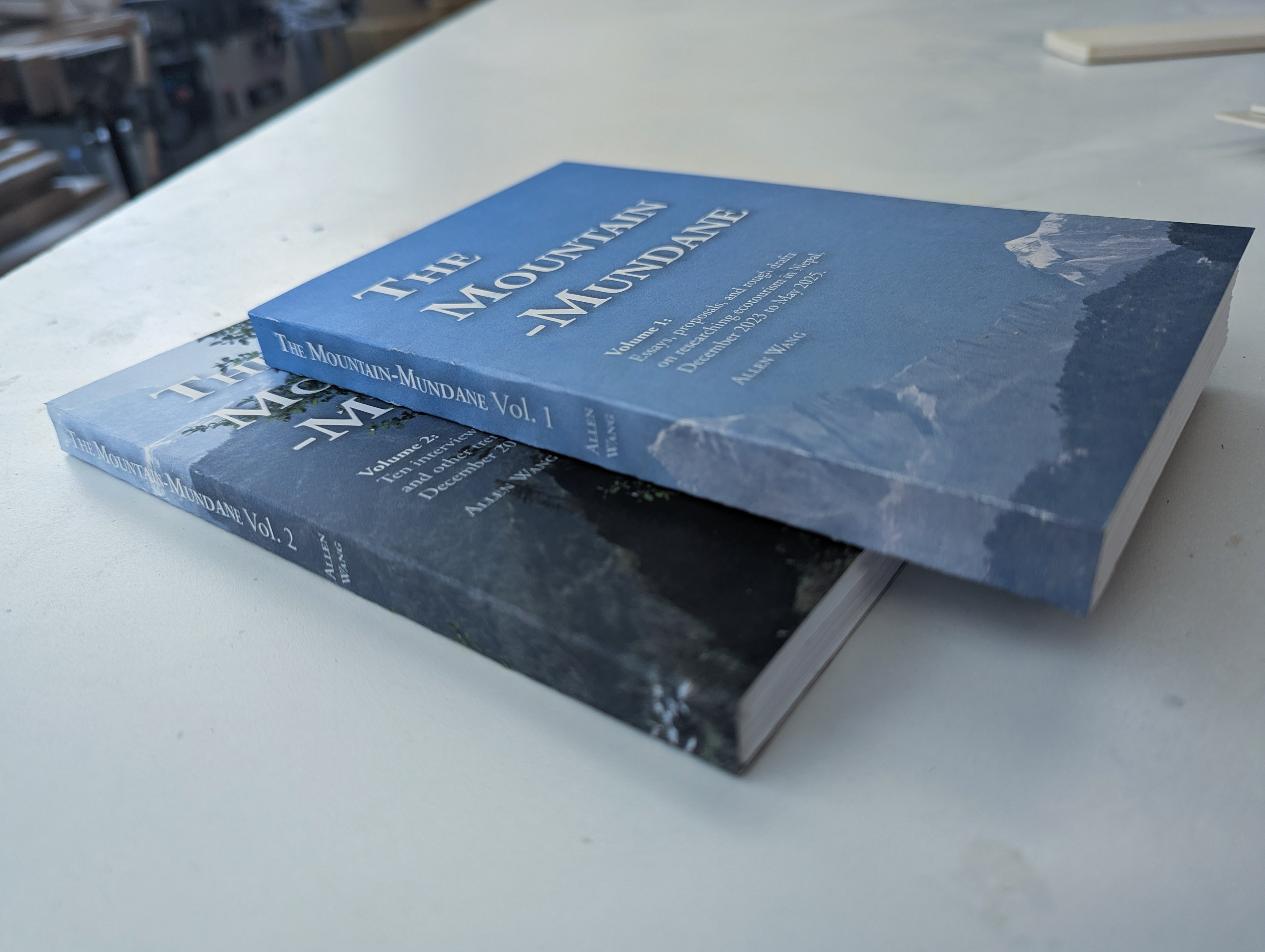
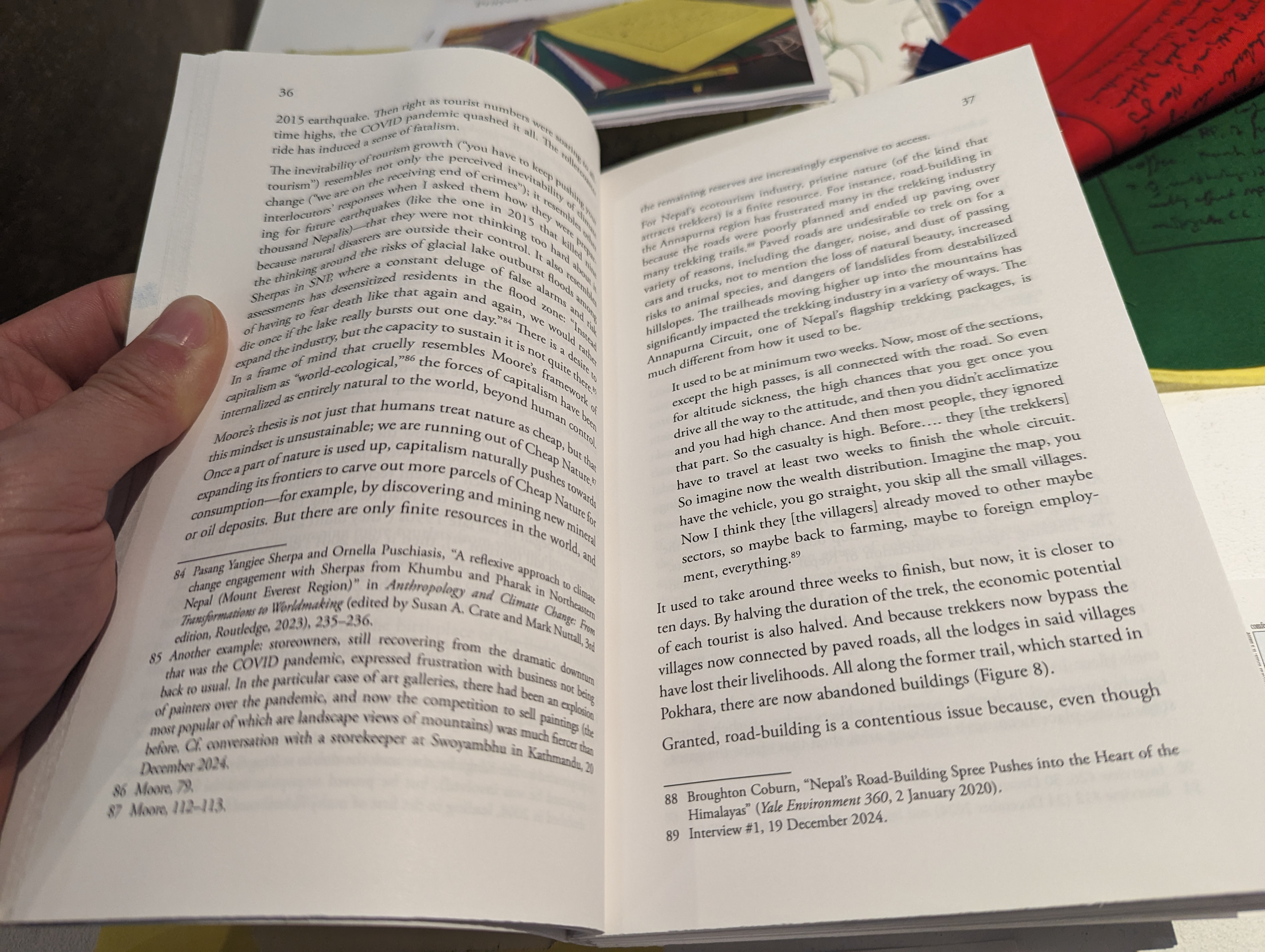
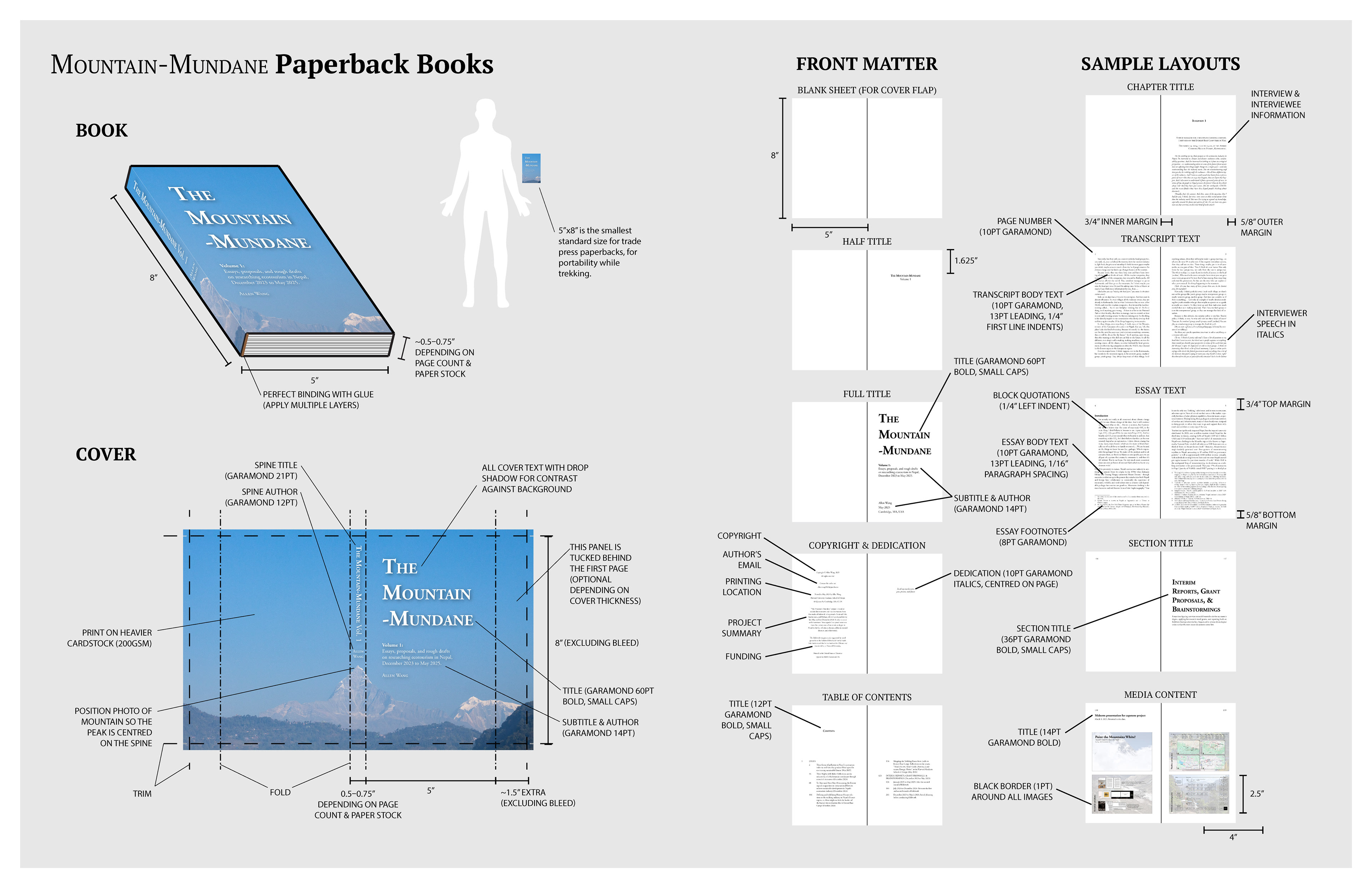
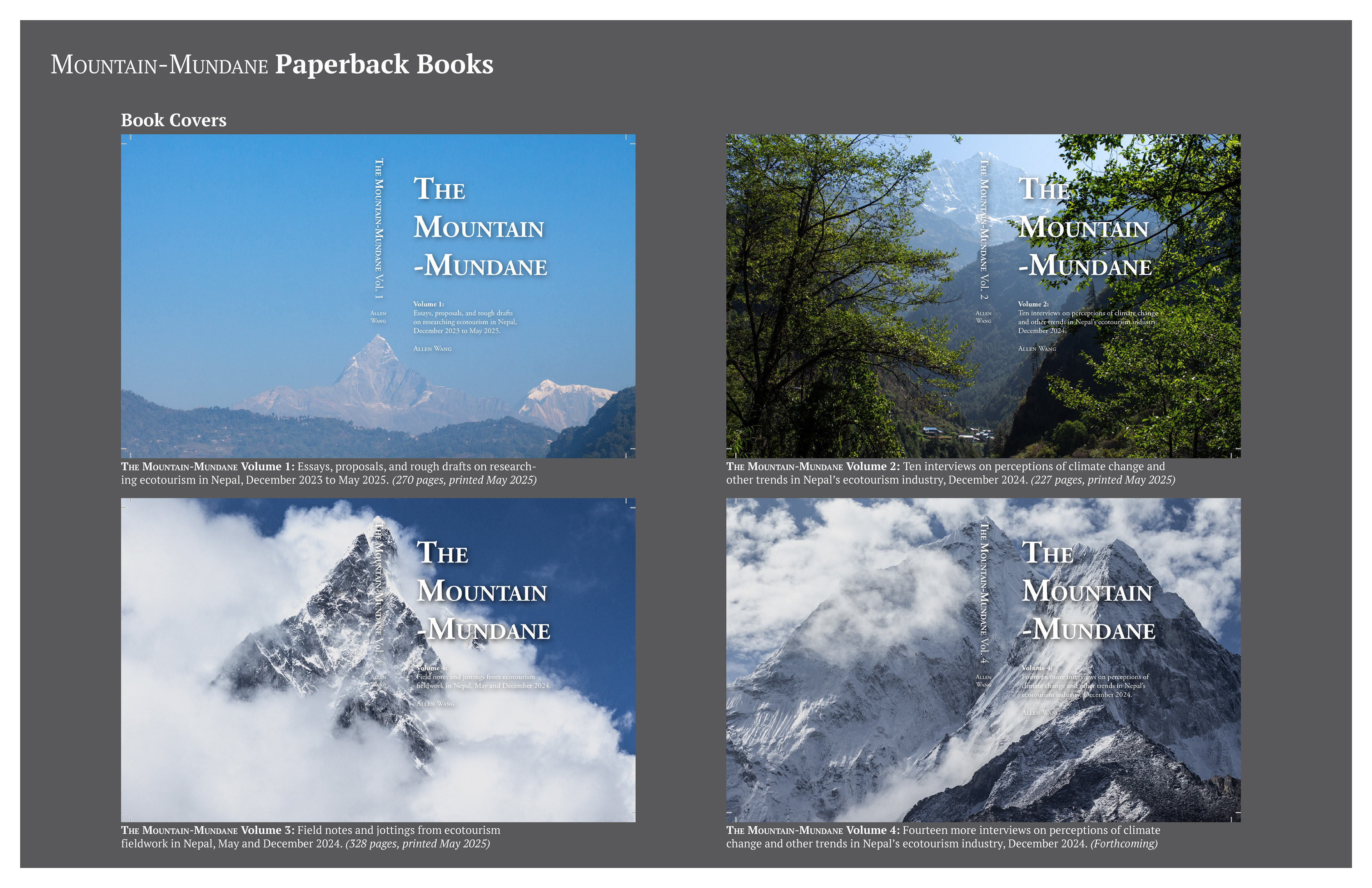
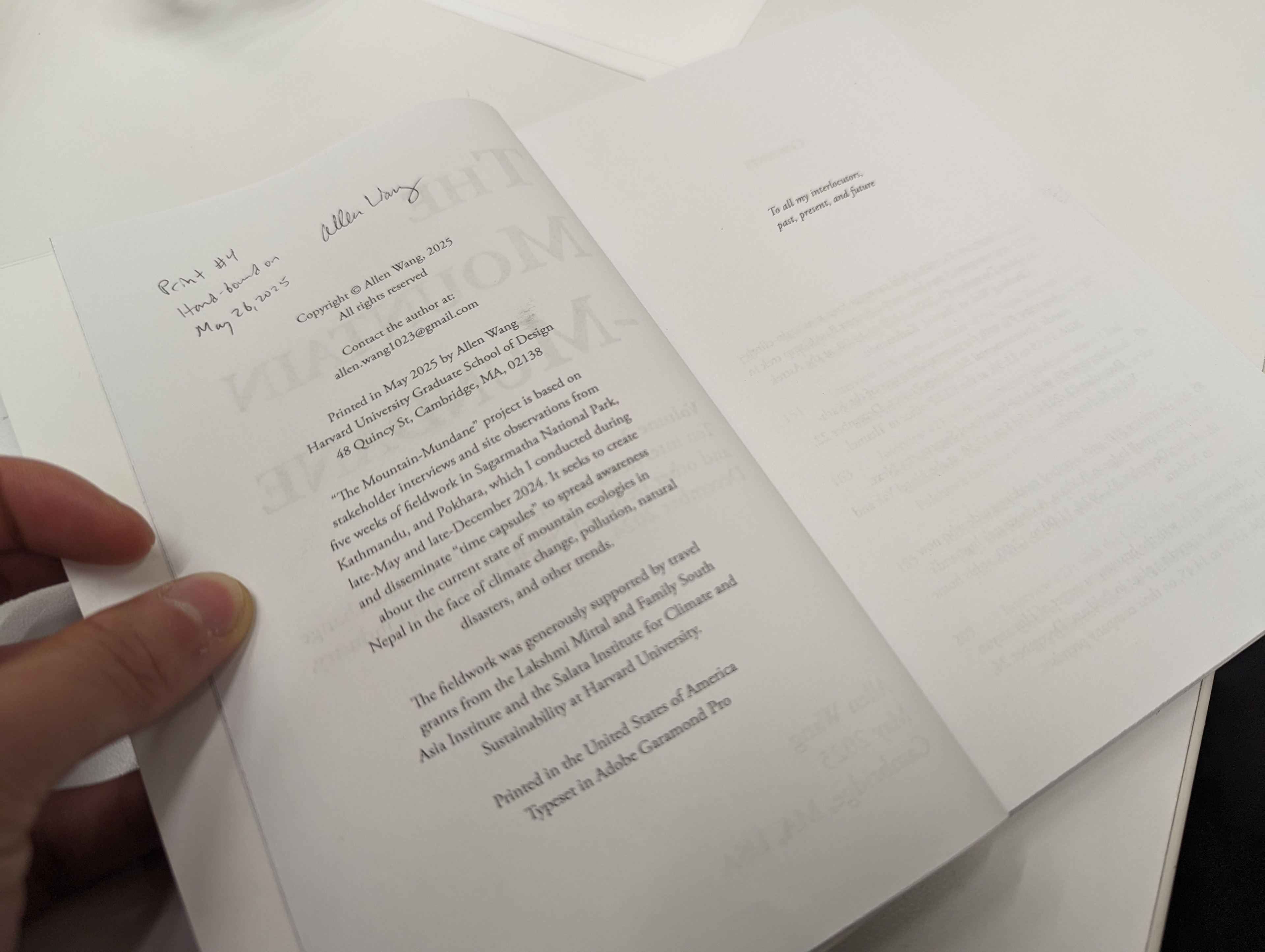
PROTOTYPE THREE: Paperback books containing documentation of my project: essays, interim reports, interview transcripts, and fieldnotes. These books are sized to 5x8” and are perfect-bound to imitate a mass-market paperback, which trekkers often bring with them. These can be sold at bookstores or archived in a library. I typeset three volumes in Adobe InDesign (one book of essays/reports, one of interviews, and one of fieldnotes), then printed, trimmed, and bound eleven copies by hand.
PART
THREE:
SHARING
THREE:
SHARING
"FINAL" EXHIBITION
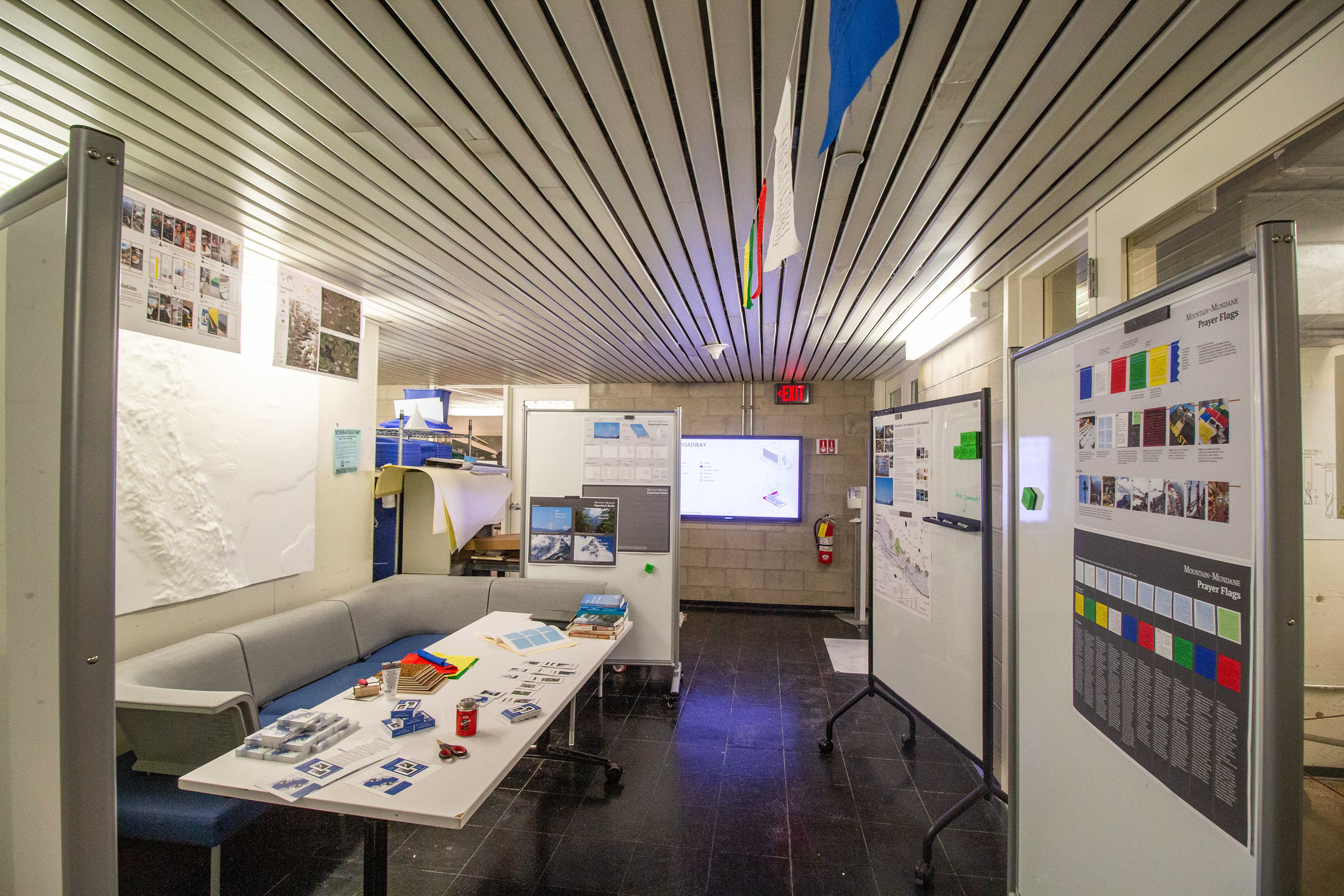
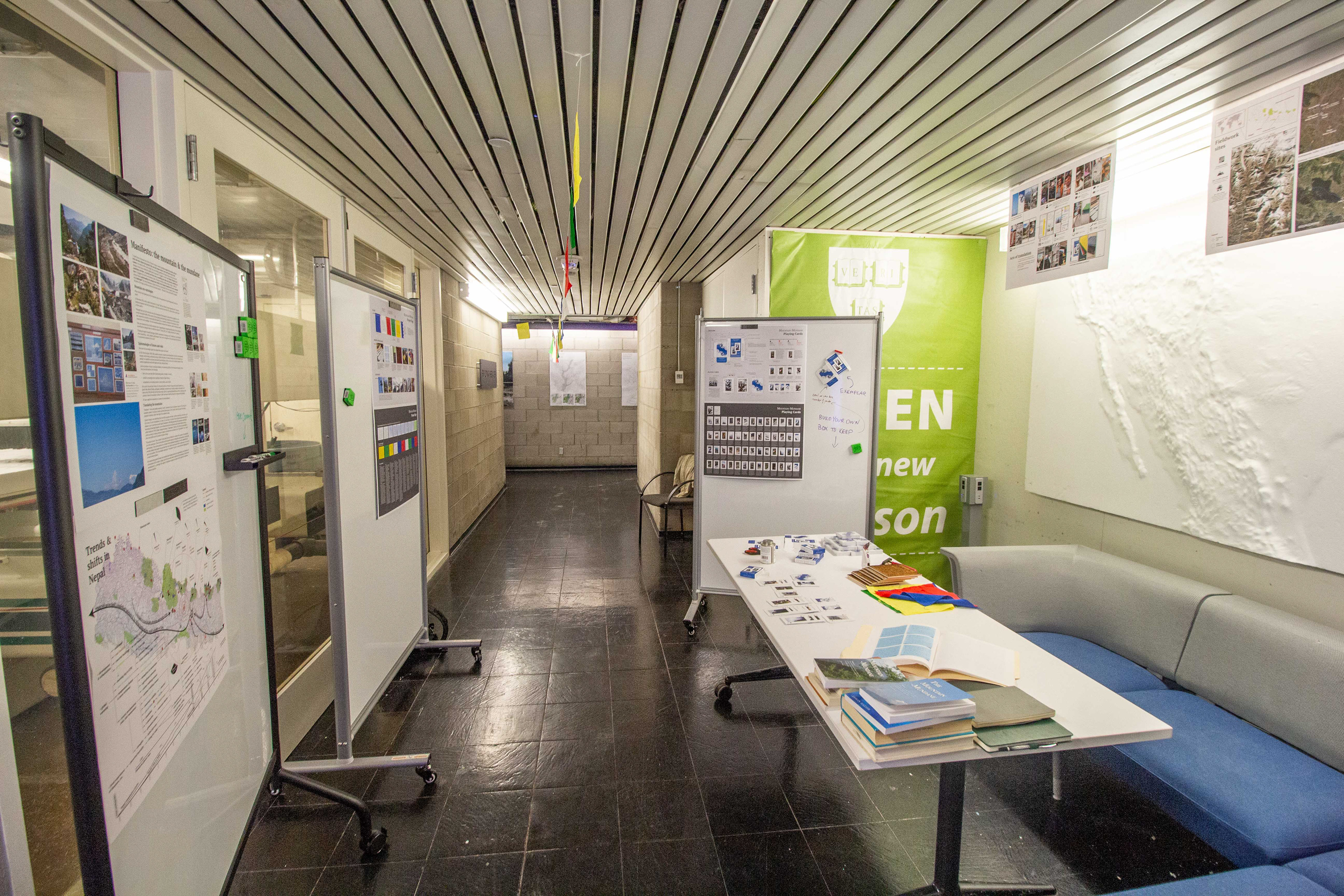
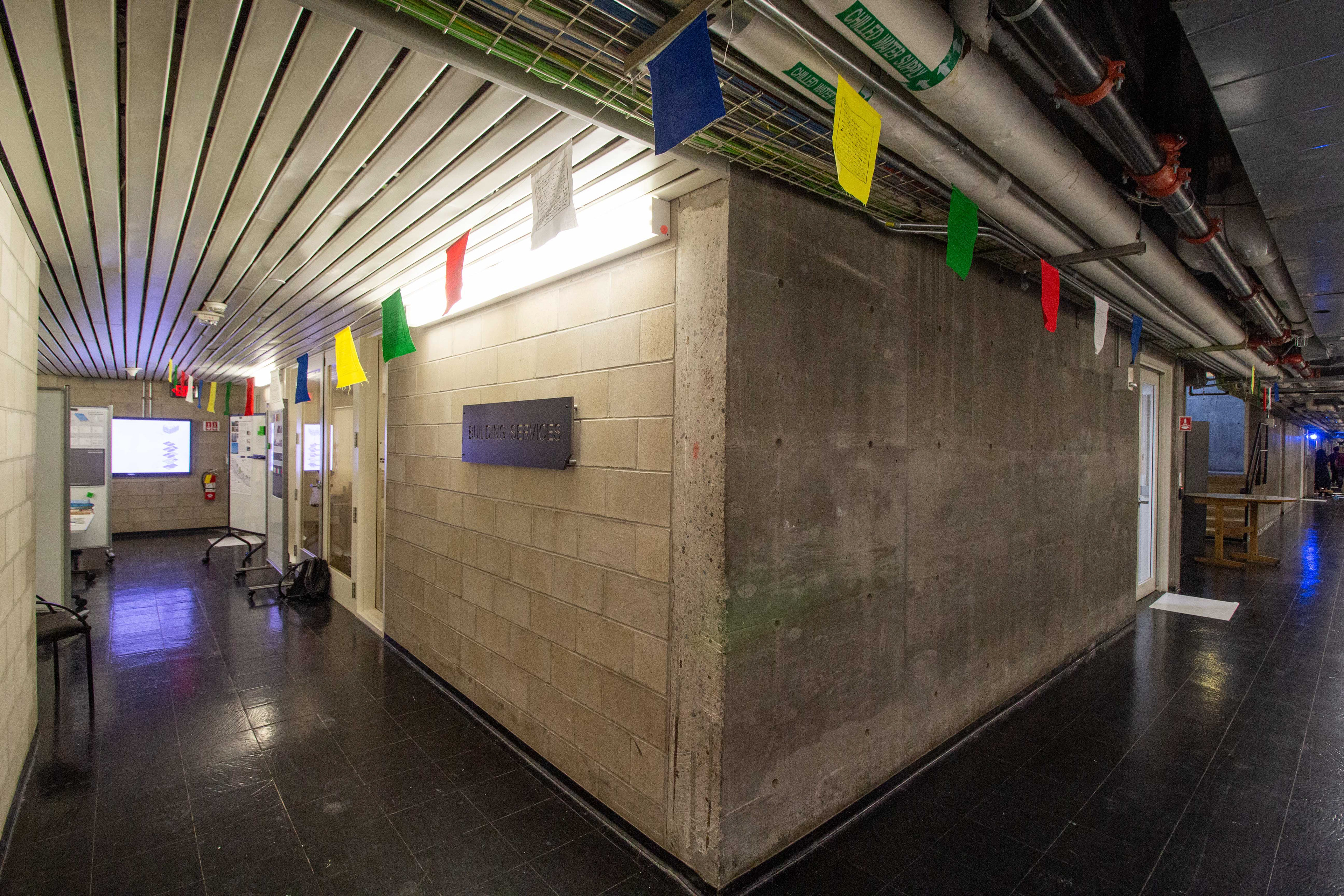
My final presentation at the Harvard Graduate School of Design on May 14, 2025 included a one-day exhibition which I installed in the school’s basement, near the fabrication studios.
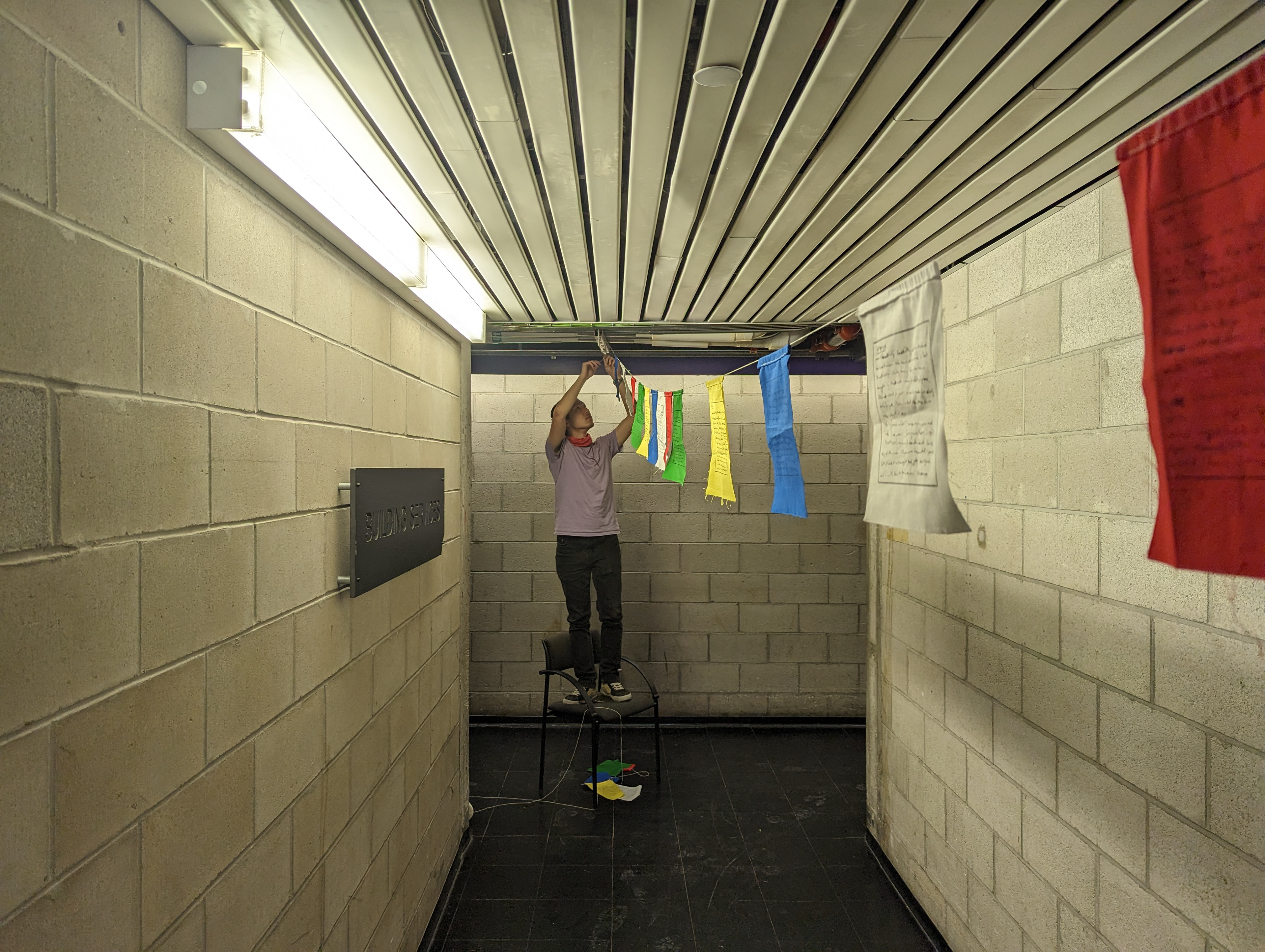
Visitors entered the basement hallway from one of two staircases and follow a line of prayer flags hanging from the ceiling. After turning a corner, they arrived at a table and couch enclosed by tall whiteboards. The cards, books, and woodblocks lay on the table, ready to be interacted with, while the posters were attached to the whiteboards or hung from the ceiling. I intended the overall impression as like a trekking experience: following a linear route until arriving at a destination in a beyul (a sacred mountain valley), where you could look up in all directions at tall “mountain peaks” (i.e., the posters) in a scenic panorama.
The exhibition also functioned as a way to distribute my prototypes: visitors were free to take a deck of cards with them if they built the box for it.
DISSEMINATION STRATEGY
This project adopts a unique approach to climate advocacy. By turning the rest of the world into a time capsule for the changes happening in the Himalayas, archiving and sharing become one and the same.
The idea is to put fragments of mountain knowledge into everyday products that can travel far from Nepal, even into the hands of people who might never see the Himalayas in person. These products aren’t just about looking pretty on a shelf; they’re meant to make climate change feel personal, tangible, and close to home.
Sometimes, this happens on a small scale. Imagine handing a deck of illustrated playing cards to a storekeeper, who then pitches and sells them to curious customers. Or picture a trekker who carries a book during their journey—something to flip through while resting for the evening—that later becomes a deeply meaningful souvenir once they’re back home.
Other times, it can happen on a large scale. Imagine partnering with institutions or companies (for example, the Nepal Tourism Board, or outdoor clothing brand Patagonia) that can distribute these products widely, ideally while also raising money for environmental work in Nepal.
In the process, we’re doing more than just storing information about the mountains in the world. We’re also creating ways for that information to help sustain the mountains(-but-not-only-mountains) themselves, even as they are threatened by climate change and other ecological trends.
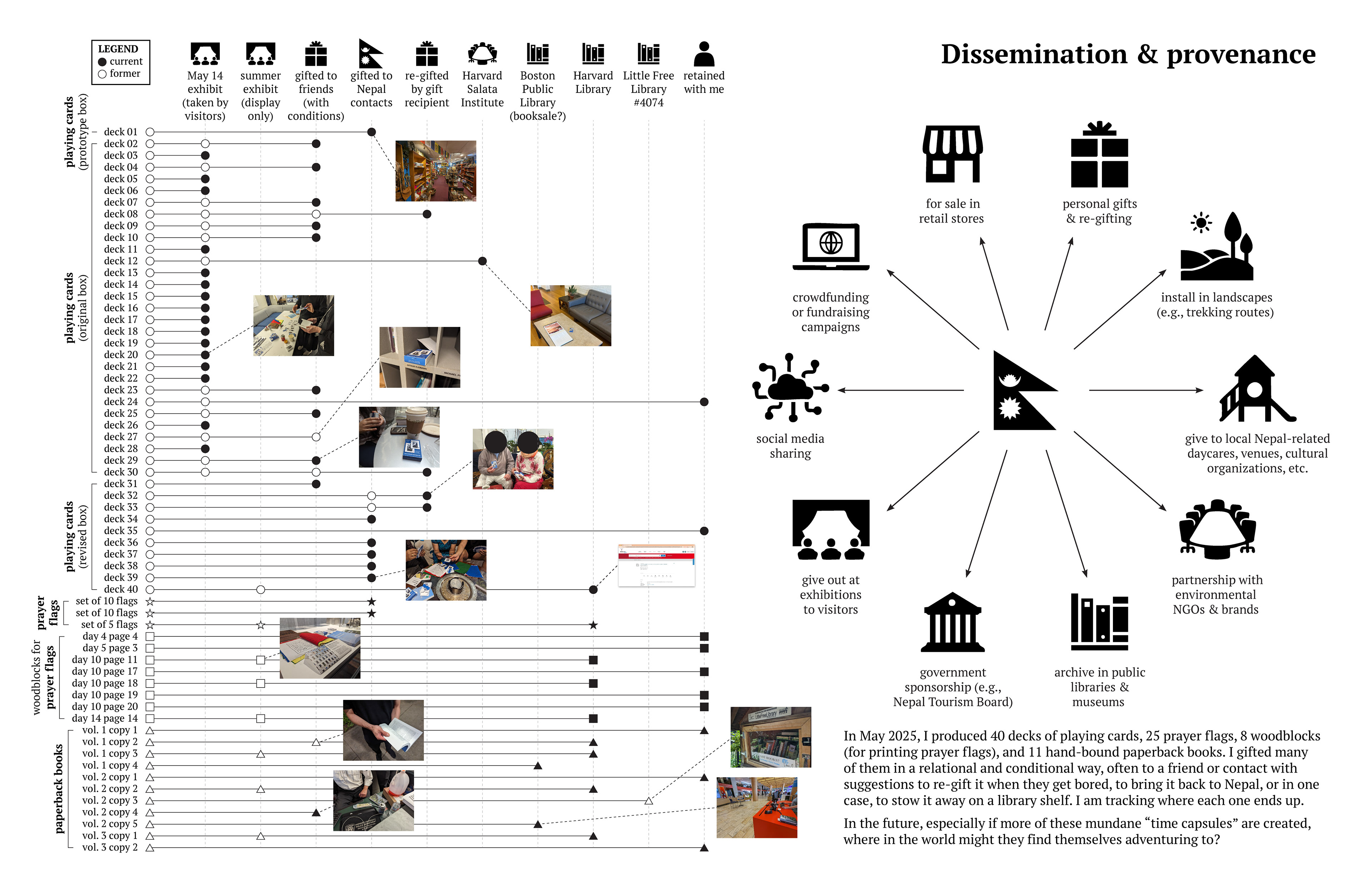
The 40 decks of playing cards, 25 prayer flags, 8 woodblocks, and 11 paperback books I produced in May 2025 were designed not only to be shared, but tracked as well. For this reason, every deck box and book has a unique numeric identifier as well as my name and email. And because most of them went to people I knew personally, we have each others’ contact information, and I asked them to keep me updated on what they end up doing with them. I have tracked the last-known owners of each prototype in a spreadsheet.
In general terms, some of the dissemination included:
—taken by visitors to my May 25 exhibition
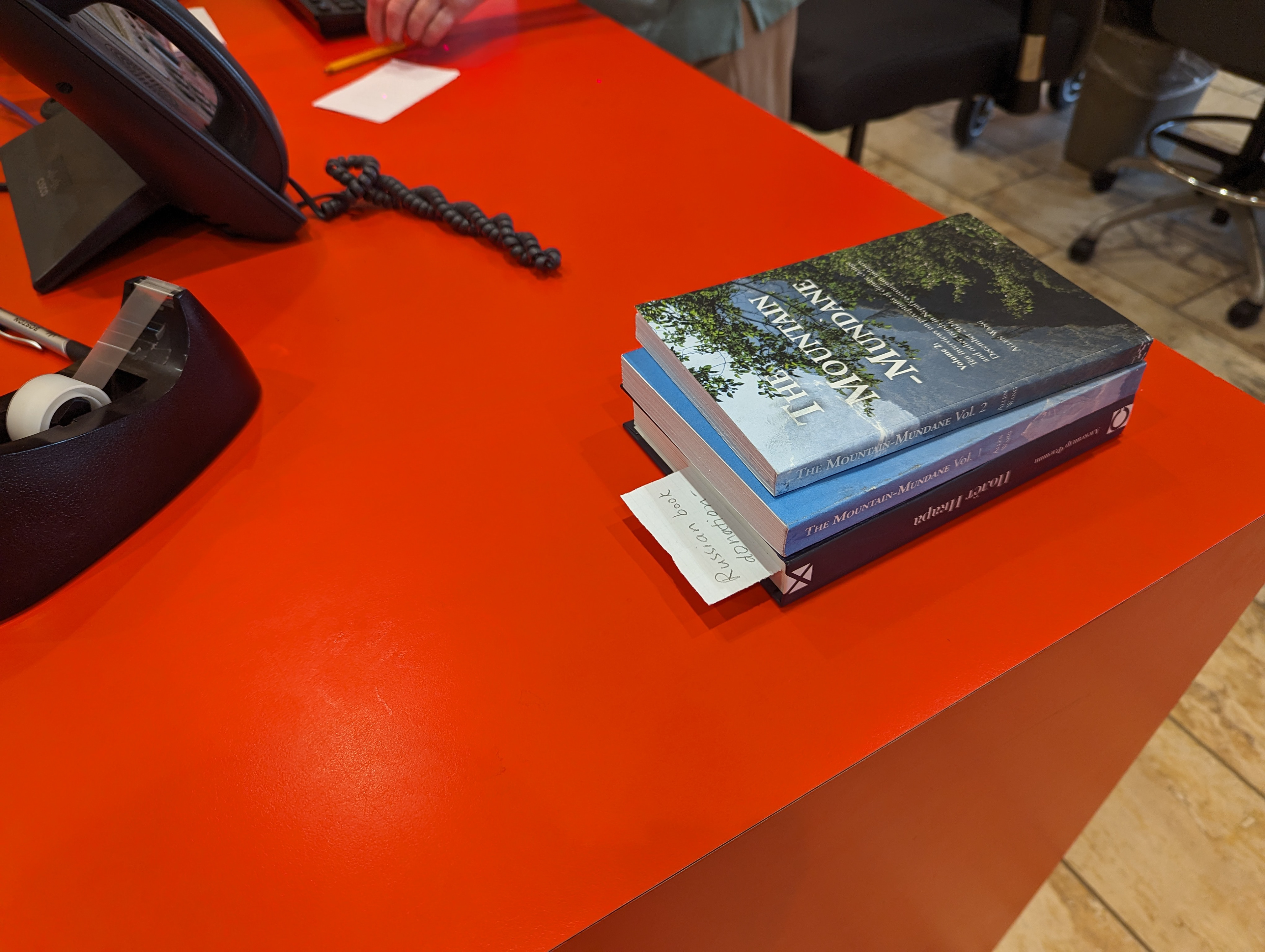
—gifted to friends, classmates, professors, university staff, and local contacts with connections to Nepal (sometimes with suggestions to regift them if they go unused, to bring them back to Nepal, or to shove a book inconspicuously onto a library shelf)
—donated to the Boston Public Library (where it likely went to a book sale)
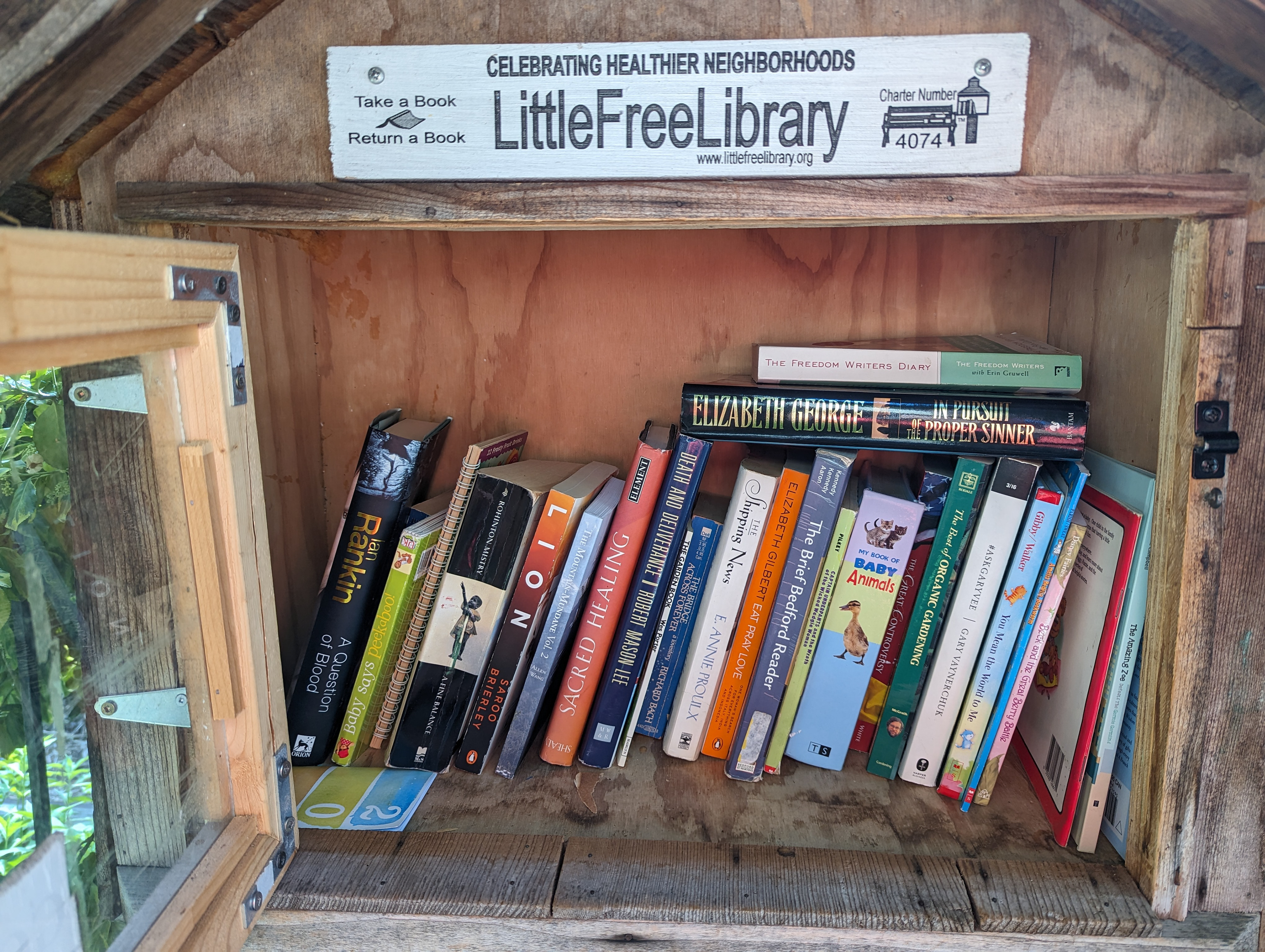
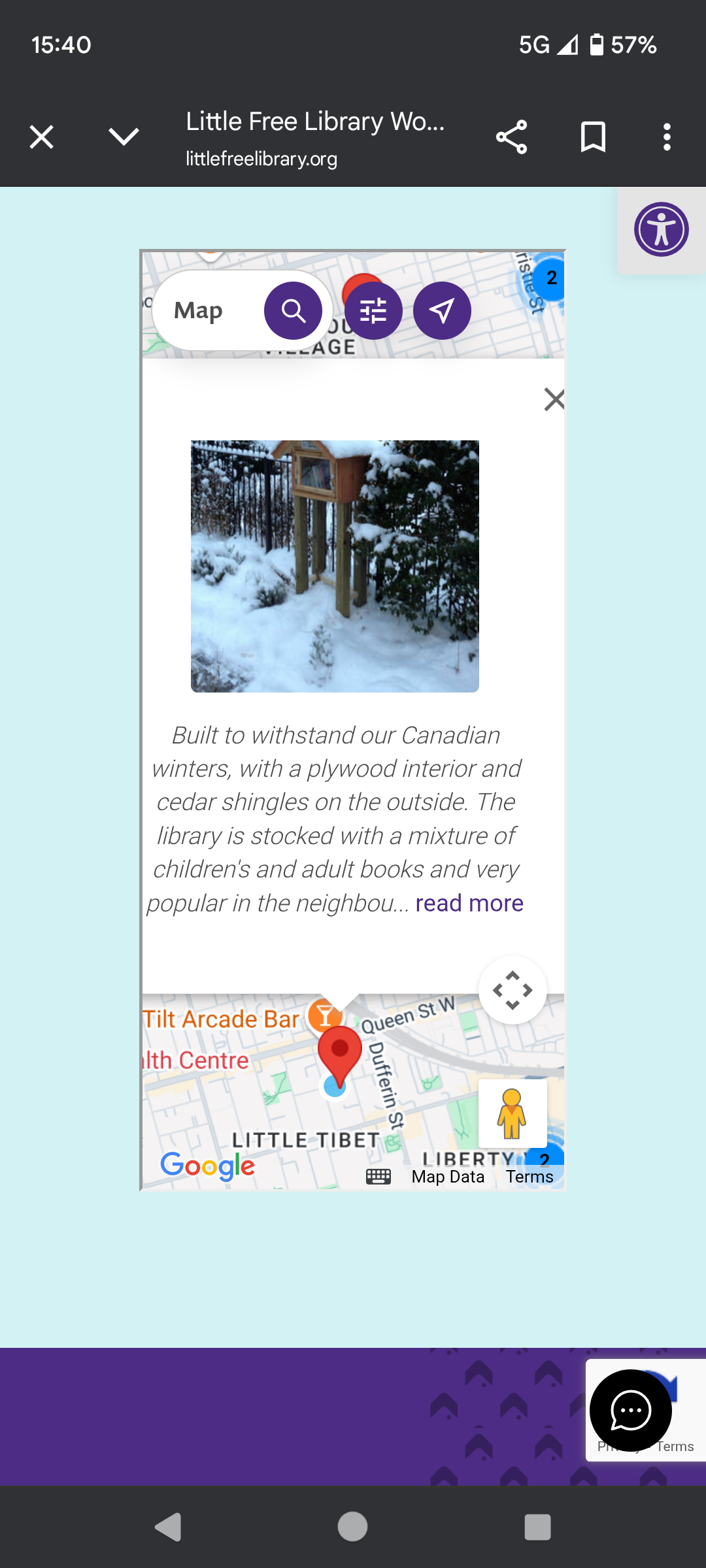
—left in Little Free Library #4074, located in Toronto's Little Tibet neighbourhood at 35 Melbourne Ave (as of January 2026, the book is no longer there)
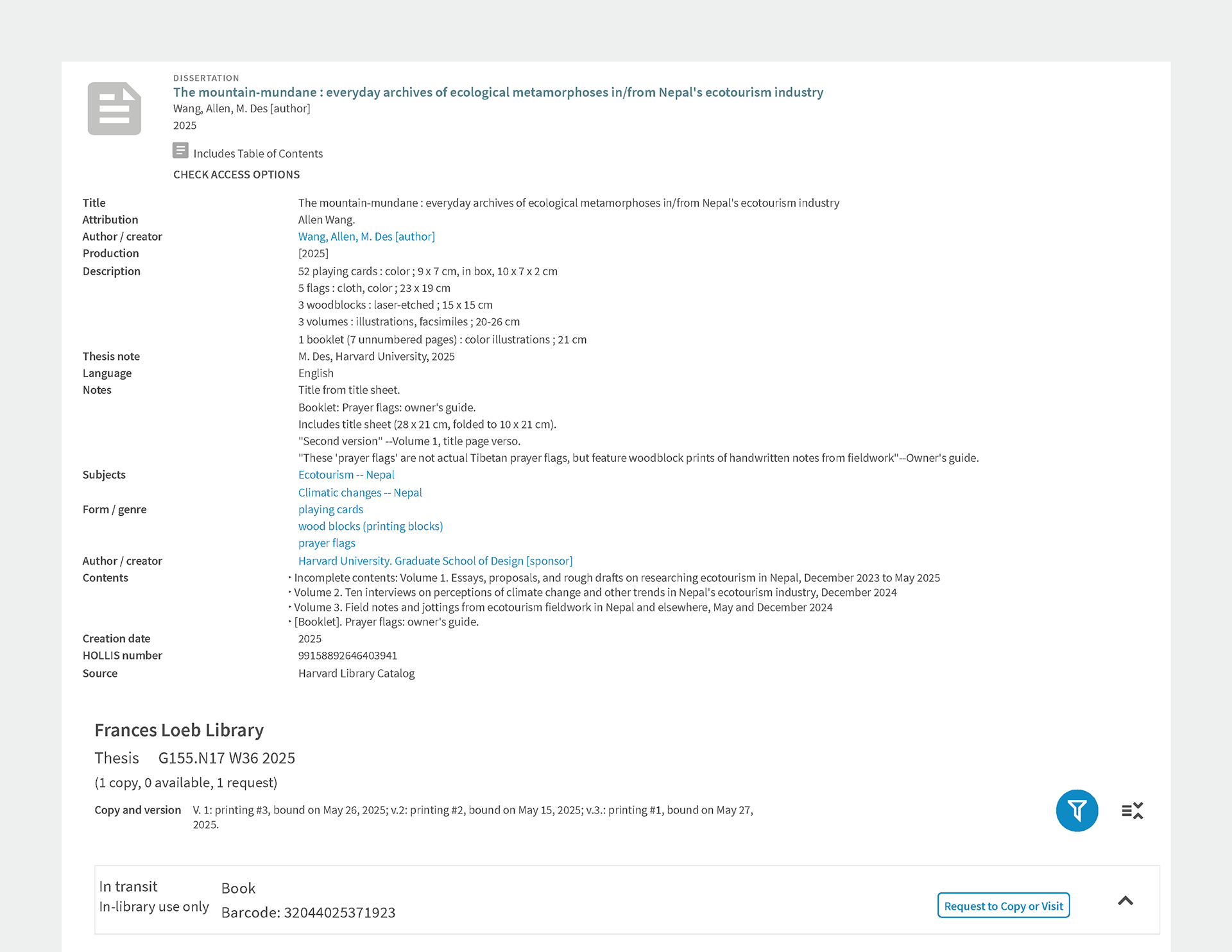
—archived for perpetuity in Harvard's Frances Loeb Library, as HOLLIS #99158892646403941 and the Library of Congress classification G155.N17 W36 2025 (i.e., geography > travel & tourism > Nepal)
—kept with me for future use
If you ever find one of these prototypes, please let me know!


conclusion
The MOUNTAIN-MUNDANE is more than just a collection of artifacts tied together by a shared manifesto. It is an experimental prototype for a new design research and environmental advocacy practice. It challenges the boundaries between fieldwork and fabrication, between data and storytelling, between the monumental and the everyday.
By embedding the lived experiences of Nepal’s ecotourism stakeholders into portable products, I sought to reframe the mountains not only as places of exceptional beauty, but also as time capsules of environmental change—ones that can travel, be bought and sold, and spark conversation far from their source. This strategy resists the idea that archives must be static or remote; instead, it turns them into things that circulate, mingle, and make climate knowledge intimate.
This project is also, unavoidably, a reflection of my own skillset and personality. I thrive on gathering large amounts of information during fieldwork (whether through notetaking or photos), on sweating out the details while creating imitations of everyday products, and on ordering sets of data into taxonomies and archives. The more I engaged with the changing landscapes of Nepal through this project, the more I grasped my own landscapes—my habits, my curiosities, and my values.
If the mountains are in a moment of metamorphosis, then so am I. This project is a record of that change. It is also an invitation: to see the extraordinary in the everyday, and to act—in the small but tangible ways that we know how—to preserve the things we care about before they disappear for good.
Acknowledgements
I wish to thank many people who have been instrumental for assisting or advising me throughout this project, which originated in January 2024 and has sustained three (out of four) semesters of my studies at Harvard.
These include professors in whose courses I worked on the project, advisors from outside the university for their continued engagement, and technical staff for assistance with prototyping: Marina Otero Verzier, Pablo Pérez-Ramos, Diane Davis, Abby Spinak, Naomi Oreskes, Arthur Kleinman, Martina Maria Keitsch, Christopher Howard, Bijay Singh, Ekraj Sigdel, Oona Gaffney, Marco Martins, and Irina Goldstein. This is surely not an exhaustive list.
I am thankful for the funding (and other support) I received from the Lakshmi Mittal and Family South Asia Institute and the Salata Institute for Climate and Sustainability, both at Harvard University. Thank you as well to the university’s research ethics board, which reviewed and approved my fieldwork as protocol IRB24-1424.
Next, I wish to thank all of my classmates, guest critics, and audiences who provided invaluable feedback throughout the many iterations of my project, as well as my friends and family for their continued support.
Finally, I wish to thank all of my interlocutors in Nepal, without whose time and generosity this project would not have been possible. In addition to a plethora of small businesses and families, my interlocutors came from the following organizations: Sagarmatha Pollution Control Committee, Sagarmatha Next, Blue Waste to Value, Kathmandu Environmental Education Project, Nepal Mountain Academy, Nepal Mountaineering Association, Himalayan Life Plastic, Green Road Waste Management, GVI Nepal, WWF Nepal, Governance Lab, Annapurna Conservation Area Project, Trekking Agencies’ Association of Nepal, and the Nepal Tourism Board.